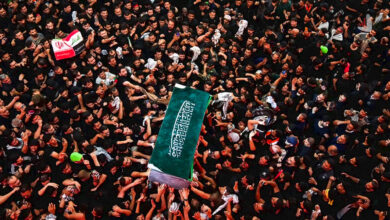
The funeral procession for Iran’s leader challenged American and Israeli assumptions about Iranian society.
According to Atlas Diplomacy, a report titled “The Crowd Vowing Vengeance for Ayatollah Khamenei Will Reshape the Middle East,” written by the Kayhan News Desk and published in the Kayhan newspaper, examines the relationship between the social mobilization that followed the assassination of Iran’s leader, the continuing military confrontation with the United States, and the consolidation of Tehran’s leverage in the Strait of Hormuz. It presents these developments as evidence that Washington and Tel Aviv miscalculated when they expected Iran’s domestic cohesion to collapse. What follows is a summary of the report.
The mass funeral processions for Ayatollah Khamenei in cities across Iran and Iraq, unfolding as the war continued and tensions in the Strait of Hormuz intensified, became a new display of the connection between social mobilization, political legitimacy, and Iran’s regional power. The presence of enormous crowds cast doubt on the narrative that domestic cohesion would rapidly disintegrate following the assassination of Iran’s leader. It also demonstrated that, at critical moments, external pressure can strengthen national and religious solidarity.
On the military front, renewed U.S. attacks on Iran’s southern provinces were met with Iranian missile and drone strikes against American bases and logistical facilities in several countries across the region. At the same time, Iran continued to insist on controlling the passage of vessels through the Strait of Hormuz, requiring ships to obtain authorization and follow designated maritime routes. The sharp decline in shipping traffic, along with mounting concern among energy companies and oil-tanker owners, showed that the Hormuz dispute had moved beyond the realm of a maritime disagreement and had become Tehran’s most important source of leverage against Washington.
In the diplomatic arena, Donald Trump’s announcement that the ceasefire had ended was accompanied by behind-the-scenes efforts to bring the parties back to the memorandum of understanding. The visit of Qatari mediators to Tehran, and their coordination with the United States, indicated that Washington—despite threatening further attacks—remained deeply concerned about the economic and security consequences of an all-out war. This contradiction between military escalation and appeals for de-escalation has laid bare the limits of America’s available options.
Disagreements have also emerged within the U.S. administration over the continuation of the war, the reimposition of sanctions, and the risk of a complete closure of the Strait of Hormuz. Some officials have argued for greater military pressure, while others have warned of Iranian retaliation, rising energy prices, and the domestic political consequences of the war ahead of the midterm elections. From this perspective, the earlier memorandum failed to resolve the fundamental disputes over commercial shipping, sanctions, and the extent of Iran’s regional influence.
At the same time, assessments concerning the possibility of once again blockading Iranian ports have emphasized the practical difficulties of such an option. The absence of any evident internal rupture, Iran’s capacity to retaliate, and the vulnerability of global energy flows all reduce the prospects that a renewed maximum-pressure campaign would succeed. The possibility that the Hormuz crisis could become linked to maritime threats in the Bab el-Mandeb Strait would extend the scope of the danger well beyond the Persian Gulf.
The symbolic dimensions of the funeral processions have also assumed strategic importance. The transfer of the body between Iran and Iraq, the mass public participation, and the chants demanding vengeance presented an image of religious and regional solidarity that ran counter to American and Israeli expectations that Iranian society would distance itself from the governing establishment. This social mobilization does not necessarily amount to complete political consensus, but it revealed the government’s ability to transform public mourning into a demonstration of cohesion and deterrence. Taken together, the convergence of mass funeral processions, military resistance, and control over the Strait of Hormuz suggests that the assassination of Iran’s leader has not produced an immediate collapse of the country’s political order. On the contrary, it may create conditions that strengthen Tehran’s position in regional negotiations. Should this trajectory continue, it could reshape the security balance in the Persian Gulf and further increase the strategic costs borne by the United States and Israel.