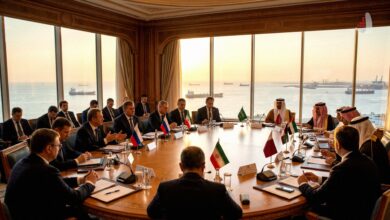
The world has not yet entered a global war and remains in a condition of competitive anarchy.
According to Atlas Diplomacy, an article titled “World War or Ordinary Anarchy?” written by Ivan Timofeev and published by the Russian International Affairs Council compares today’s crises with past world wars. It argues that the international system has not yet entered a global war, but instead remains in a dangerous anarchic condition in which states compete for security, influence, and resources in the absence of any higher authority. What follows is a summary of the article.
The simultaneous crises in relations between Russia and the West, the war in Ukraine, U.S. and Israeli military operations against Iran, and the conflicts in Gaza and Yemen present an image of a disorderly world at risk of wider war. Yet the proliferation of armed conflicts, combined with the simultaneous use of military, sanctions, intelligence, and cyber instruments, does not by itself mean that a world war has begun. The current situation is better understood as the open return of anarchy in the international system: an environment in which states pursue their security and interests through competition, deterrence, and alliance-building, without the presence of a superior and legitimate authority capable of restraining violence.
Historically, a world war requires the involvement of a substantial number of major powers, the broad geographic expansion of hostilities, and the formation of relatively coherent camps. The First and Second World Wars were fought between clearly defined coalitions that employed a wide range of military, economic, and propaganda tools in pursuit of the opposing side’s total defeat. The Cold War, although it never escalated into a direct nuclear confrontation, also possessed a global structure, placing two military, economic, and ideological blocs in opposition to one another.
No comparable structure is visible today. The war in Ukraine, the Persian Gulf crisis, tensions between India and Pakistan, disputes between China and India, and conflicts in the Caucasus do not follow a single logic. Russia, Iran, and China cooperate with one another, but they have not formed a military alliance based on mutual defense commitments. On the other side, the United States maintains an extensive network of allies, but no coherent global coalition has yet emerged against it. Countries of the Global South also have divergent goals, dependencies, and relationships, and cannot be treated as a single political or strategic camp.
The absence of a shared alternative ideology has also prevented the emergence of two global fronts. The West continues to draw on political concepts inherited from the Cold War, but Russia, China, India, and other powers have yet to articulate a common political philosophy around which a rival bloc could be organized. Even the widespread use of hybrid warfare, information operations, cyberattacks, and financial sanctions does not alter the fundamental nature of the crisis. Such instruments have a long history, and technology has merely increased their speed and reach.
In this environment, the security dilemma remains decisive: an increase in one state’s military capabilities, even when intended for defensive purposes, is perceived by its rivals as a threat, leading to arms races or the formation of new alliances. States are therefore compelled to choose among self-reliance, alignment with powers of roughly equal strength, or acceptance of protection from stronger powers. The central problem facing the world today is therefore not a world war, but a dangerous form of anarchy that could produce global consequences through miscalculation or the uncontrolled escalation of crises. A direct confrontation between nuclear powers, widespread disruption of supply chains, or the merging of several regional wars could push the international system into a qualitatively different phase. The confrontation between Russia and the West, meanwhile, remains an extension of the crisis created by the end of the Cold War and the struggle over the post-Soviet space, rather than one theater of an already existing world war. Recognizing this distinction matters, because the appropriate response to anarchy is crisis management, containment, and the prevention of linkages among separate conflicts—not policymaking based on the assumption that two consolidated global camps already exist.