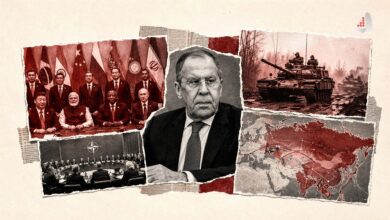
America’s shrinking margin for error has strengthened Iran’s regional position.
According to Atlas Diplomacy, the article “The War That, Instead of Destroying Iran, Turned It into the Region’s Dominant Power,” written by Avner Ben-Zaken and published in Haaretz, examines the consequences of the war against Iran within the broader context of the decline of the unipolar order. It views Tehran’s growing regional power as evidence of the narrowing of America’s strategic freedom of action and the weakening of Benjamin Netanyahu’s political model. What follows is an abridged version of the article.
Beyond its immediate military outcomes, the recent war against Iran is regarded as a sign of a deeper transformation in the regional and global balance of power. The confrontation demonstrated that the United States no longer enjoys the expansive freedom of action it possessed during the decades following the collapse of the Soviet Union—a period in which Washington could absorb the costs of its strategic mistakes without suffering a serious change in its global standing. The rise of China, Russia’s resurgence, and the growing power of regional actors now mean that every costly American decision can become an opportunity for its rivals.
The special relationship between the United States and Israel also took shape and grew stronger within the context of this unipolar order. Military cooperation between the two countries developed during the 1960s, deepened during the 1973 war, and, after the end of the Cold War, reached a level at which Washington could provide extensive support to Israel with almost no concern about the strategic consequences. This support not only enhanced Israel’s military capabilities, but also allowed its leaders to pursue high-risk regional policies while relying on American backing.
Benjamin Netanyahu benefited from this structure more than any other Israeli leader. He expanded his ties with the American conservative movement, confronted the administration of Barack Obama, and proceeded on the assumption that the Washington–Tel Aviv alliance would not be seriously affected by the polarization of American domestic politics. The Donald Trump administration’s withdrawal from the Iran nuclear agreement in 2018 also appeared to confirm the success of this strategy, as American policy became more closely aligned than ever with the demands of the Israeli government.
The recent war, however, exposed the limits of this model. The declared objective was to contain and weaken Iran, but Tehran’s continued capacity to retaliate, together with the difficulty of controlling the scope of the conflict, demonstrated that military superiority does not necessarily produce the desired political outcome. Iran succeeded in consolidating its position within the security equations of the Persian Gulf and increasing the cost of any attempt to exclude it from regional arrangements. Consequently, a war that was intended to constrain Iranian power instead highlighted the country’s strategic importance and strengthened its bargaining position.
The principal consequence of this transformation is the narrowing of America’s margin for error. Washington can no longer compete with China and Russia while simultaneously entering costly conflicts in the Middle East and expecting its global standing to remain unharmed. Every miscalculation can now lead to the depletion of resources, the erosion of deterrence credibility, and the expansion of rival powers’ influence.
The end of the unipolar order is also destabilizing the political foundations of Netanyahu’s long tenure. His strategy rested on the existence of an America capable of providing unlimited support and absorbing the consequences of Israeli decisions. As that capacity becomes more constrained, Israel’s regional policy will inevitably face greater limitations. The outcome of the war, therefore, is not merely a change in Iran’s position. It is also a sign of a transition toward an international order in which the United States, Israel, and other actors must bear the costs of their mistakes more directly—and more quickly.