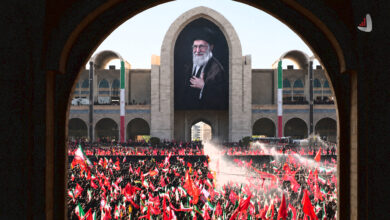
The choice of Ayatollah Muhammad Taqi al-Hakim to lead the funeral prayer turned the ceremony into a message about the ties between Najaf and Tehran, the endurance of Iran’s regional influence, and its political resilience.
The transfer of the late leader of the Islamic Republic of Iran’s remains to Iraq, and their passage through Najaf and Karbala as part of a multi-city, cross-border procession, amounted to far more than a religious rite. This rare event carried emotional and ceremonial significance, but it also became a stage on which political meanings were redefined, transnational Shiite bonds were displayed, and rival narratives of power competed for recognition. The selection of Ayatollah Sayyid Muhammad Taqi al-Hakim to lead the funeral prayer over the body of the Revolution’s martyred leader gave the ceremony a meaning that extended well beyond mourning. It turned the funeral into a layered message about Najaf’s standing, Iranian-Iraqi relations, and Tehran’s ability to preserve its symbolic influence after the war.
The Selection of Ayatollah al-Hakim and the Transnational Meaning of the Funeral
The selection of Ayatollah Sayyid Muhammad Taqi al-Hakim, brother of Grand Ayatollah Sayyid Muhammad Sa‘id al-Hakim, to lead the prayer at the Shrine of Imam Ali—peace be upon him—was not merely a ceremonial decision. It was initially thought that Grand Ayatollah Sayyid Ali al-Sistani, Iraq’s preeminent Shiite religious authority, might assume this responsibility. His office, however, announced that physical limitations would prevent him from attending. Ayatollah Muhammad Taqi al-Hakim, a well-known figure in the Najaf seminary, was therefore chosen to perform the role.
The meaning of this choice must be understood in light of the al-Hakim family’s position within Iraq’s Shiite religious establishment and political history. Grand Ayatollah Sayyid Muhsin al-Hakim was one of the leading sources of emulation in the Shiite world during the mid-twentieth century, while members of his family faced extensive repression under Baathist rule. After emigrating to Iran, Ayatollah Sayyid Muhammad Baqir al-Hakim founded the Supreme Council for the Islamic Revolution in Iraq in 1982, with the Badr Organization later becoming its military wing. Following Saddam Hussein’s fall, the al-Hakim family once again emerged as one of the influential currents in Iraqi Shiite politics.
Muhammad Taqi al-Hakim’s presence at the heart of the ceremony therefore served several purposes at once. It demonstrated respect for Najaf’s independence and religious authority, recalled the al-Hakim family’s historical relationship with Iran, and helped prevent the funeral from being perceived solely as a program designed by Tehran. His selection bestowed both Iraqi and seminary-based legitimacy on the ceremony without concealing the family’s historical and political ties to the Islamic Republic.
The funeral of Iran’s leader in Iraq carried geopolitical importance in three respects. First, it illustrated the profound transformation in relations between the two countries. Iraq, which fought an eight-year war against Iran during the 1980s, was now hosting a public commemoration for its neighbor’s highest political and religious authority. The ceremony was widely interpreted as evidence of the endurance of Iranian influence in Iraq after Saddam’s fall—an interpretation that, more than anything else, reflected Tehran’s altered position within Iraq’s political and social structures.
Second, the choice of Najaf and Karbala connected the funeral to the sacred geography of Shiism. These cities were not simply venues for ceremonial proceedings; they endowed the event with religious and historical capital that could not have been reproduced in Tehran. The funeral’s coincidence with the month of Muharram further strengthened its religious and symbolic language, allowing the official narrative to represent the loss of Iran’s leader through the intertwined themes of martyrdom, Resistance, and historical continuity. In this sense, religious ritual became an instrument of ideological diplomacy.
Third, the ceremony became a measure of the Islamic Republic’s capacity for political and social mobilization after the attacks. The presence of a crowd numbering in the millions in Najaf, together with the prominent display of flags, portraits, and political slogans, indicated that the ritual had not remained confined within Iran’s borders. Such participation does not, in itself, demonstrate complete consensus in support of the Islamic Republic. It does, however, show that religious and political networks aligned with Iran continue to possess considerable mobilizing capacity inside Iraq.
Critics, of course, emphasize that Shiite groups close to Iran were responsible for much of the ceremony’s organization, and that the size of the crowd should therefore not be treated as direct evidence of uniform political support. This qualification is necessary. Yet formal organization alone, without an existing social network, a shared religious memory, and a receptive political environment, could not have produced an event of such scale and significance in a city like Najaf. The ceremony, therefore, did not prove the complete unity of the Shiite world so much as it revealed the depth of Iran’s infrastructure of influence and symbolic power in Iraq.
Narrative Warfare and Its Strategic Implications
The Najaf ceremony was simultaneously an arena of competing narratives. Media outlets close to Iran emphasized political stability, social capital, and the continuity of the Axis of Resistance. Critical media, by contrast, focused on the role of the state, armed groups, and organized mobilization. The political meaning of the ceremony emerged from the interaction of formal organization, social participation, Najaf’s religious standing, and the conditions of war in which it took place.
Donald Trump’s reaction offered a clear example of the effects of this narrative struggle. He said he had been surprised by the extensive participation of Iranians in the funeral because he had assumed that the public hated Ayatollah Khamenei. He even suggested that the tears might have been staged. At the very least, these remarks demonstrated how deeply the White House’s understanding of Iranian society had been reduced to a simplistic formula. Economic and political grievances are real, but domestic opposition does not necessarily translate into support for a foreign assassination or the collapse of national and religious bonds.
This message also mattered at the regional level. Tehran sought to turn its political survival, its capacity for mass mobilization, and its leverage over the Strait of Hormuz into assets at the negotiating table. Within this framework, the funeral was not merely a reaction to loss. It formed part of Iran’s effort to demonstrate that military pressure had failed to dismantle its political structure, its regional networks, or its determination to bargain from a position of strength.
The presence of senior Iranian and Iraqi officials in Najaf, along with the participation of foreign delegations in the broader series of ceremonies, also gave the message a diplomatic dimension. The event’s principal importance, however, lay not in the number of guests but in the connection among three distinct levels: Najaf’s religious authority, the Iraqi state, and political networks close to Iran. Bringing these three levels together did not transform the ceremony into a display of hard power. Instead, it revealed a form of relational power—power derived from the interconnection of institutions, collective memory, and social networks.
The funeral in Najaf, and the selection of Ayatollah al-Hakim, demonstrated that in today’s international system, the “war of narratives” has become an inseparable part of the equations of power. The al-Hakim family’s dual standing—as both a symbol of resistance to the Baathist regime and a bridge between Najaf and Iran—turned the choice into a vehicle for a political message of unity, continuity, and endurance.
The funeral of Iran’s leader in the heart of the Shiite world marked more than the end of an era. It also signaled a movement toward a form of “collective and distributed leadership” in which social capital, national cohesion, and religious and political networks rank among the most important elements of deterrence against the pressures of a hegemonic order. The event made clear that, in the age of narrative warfare, collective rituals and religious symbols have become inseparable from the geopolitical equations of West Asia.
Ali Rahimipour, M.A. in International Relations and Defense Management