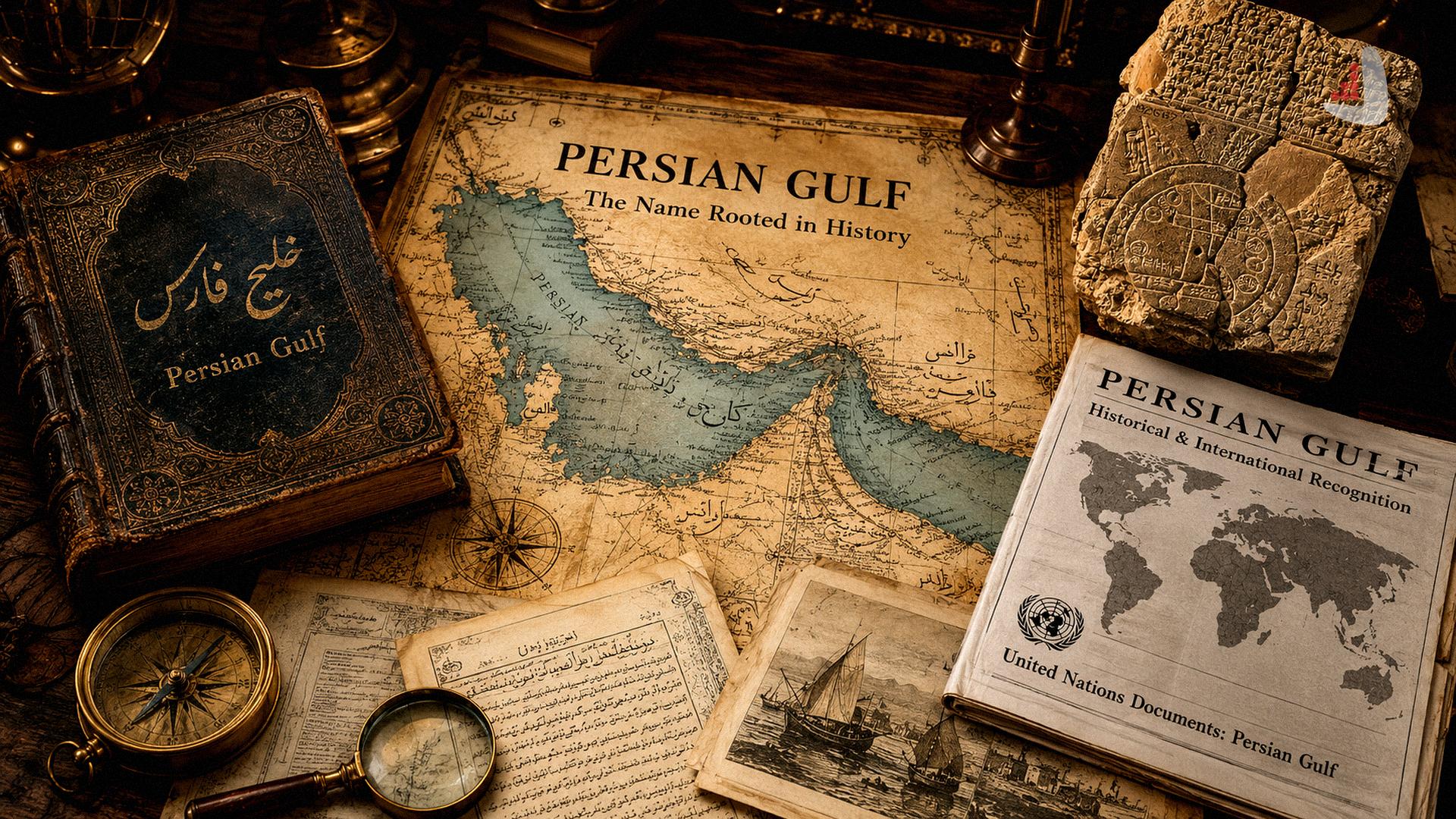
Continued political efforts to replace the name “Persian Gulf” with “Arabian Gulf” run counter to historical evidence and established international usage and risk intensifying identity-based tensions across the region.
Continued political efforts to substitute the term “Arabian Gulf” for “Persian Gulf” are inconsistent with historical evidence and established international usage. At the same time, they risk creating the conditions for renewed tensions among the countries of the region. This dispute has emerged in an environment in which some of Iran’s neighbors have, for decades, relied on U.S. security arrangements and military presence, while regional relations have long been intertwined with rivalry and intervention by outside powers.
This sensitivity can be understood in the context of Iran’s historical experience. Both before and after the Islamic Revolution, Iranian governments adopted different patterns of foreign relations in an effort to overcome their strategic loneliness. The Qajars repeatedly sought to counter the threats posed by foreign powers by relying on one power to contain the influence of another: at times turning to France or Britain against Russia, at others to Russia against Britain, and later to the United States against Soviet Russia and Britain. Ultimately, this historical experience reinforced the perception that Iran had no unconditional strategic ally. Reza Shah, too, paid the price for his indirect rapprochement with Germany amid great-power rivalry, as Iran was occupied and he was forced from power. From this perspective, the question of the Persian Gulf’s name is not merely a terminological dispute; it is also connected to Iran’s historical sensitivities regarding identity and foreign intervention.
From Political Naming to Geographic Distortion
The term “Arabian Gulf” did not emerge through an entirely spontaneous historical process. During the twentieth century, it gradually became part of the region’s political and identity-based rivalries. In the middle decades of the century, Sir Charles Belgrave, the British adviser to the ruler of Bahrain, was among the early figures to use the term. Within the intellectual milieu surrounding Sawt al-Bahrain, the replacement of “Persian Gulf” with “Arabian Gulf” was also promoted. In the 1960s, amid the rise of Arab nationalism under Gamal Abdel Nasser, this naming practice acquired greater political prominence and, against the backdrop of strained relations between Iran and Egypt, became an instrument of political contestation.
Advocates of this designation sometimes invoke classical geographical texts and the historical term “Arabian Gulf” (Sinus Arabicus). Yet on ancient maps, the term was most often applied to the Red Sea, although there are also examples of its use for the body of water between Iran and the Arabian Peninsula. This history itself demonstrates that invoking a historical term with multiple applications cannot, on its own, provide a basis for discarding the established name “Persian Gulf.”
The continuation of this dispute could place Iran’s neighbors on a path toward a protracted historical and identity-based conflict among the region’s peoples. The politics of renaming geographical features is a two-way street. Drawing on its own historical record and existing documents, Iran could likewise respond to the continuation of such an approach by revisiting the names of geographical features in its surrounding region on the basis of older sources. But the fundamental question is this: what does fueling such a dispute contribute to the development or prosperity of the region’s peoples? The answer is clear. This zero-sum game leads above all to wasted resources and the production of resentment.
At the legal and institutional level, the United Nations, in its editorial directives, identifies “Persian Gulf” as the standard term for the body of water between the Arabian Peninsula and Iran and emphasizes the use of this name in its official documents. Continued political efforts to replace the name, therefore, represent more than a linguistic disagreement; they also risk intensifying identity-based sensitivities across the region.
The reasonable course is to move away from this path and return to regional cooperation. The Islamic Republic of Iran, while emphasizing its ability to respond to such distortions, states that its priority remains economic cooperation and regional relations. Continuing the dispute over the name of the Persian Gulf is playing with fire—one that could erode lasting peace and security for future generations. Ultimately, geographical names cannot simply be erased from historical memory through political decisions; history will remain the final judge in this dispute.
Jahanbakhsh Rashidi, Researcher in Political Science and International Relations