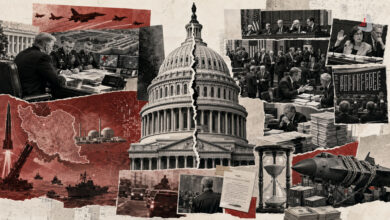
The convergence of the Shanghai Cooperation Organization summit in Bishkek and the G20 finance meeting in Asheville underscored the widening gap between post-Western institution-building and the growing difficulty of forging consensus within Western-centered mechanisms.
The convergence of the Shanghai Cooperation Organization summit in Bishkek with the meeting of G20 finance ministers and central bank governors in Asheville, North Carolina, offered a compact portrait of a new phase in global politics. In Bishkek, Eurasian powers emphasized the expansion of political, economic, energy, and technological cooperation. In Asheville, disagreements over trade, Russia, and imbalances in the global economy prevented a full consensus. This juxtaposition provides a useful entry point for understanding the deeper process of hegemonic transition and the gradual reordering of the architecture of the international system.
In the theoretical tradition of international relations, the “international order” is more than a mere distribution of material capabilities. Stable orders rest on a combination of material power, inclusive institutional structures, and normative legitimacy. According to hegemonic stability theory, a preeminent power must provide “international public goods” such as collective security, a relatively open trading system, and stable monetary mechanisms if it is to secure other actors’ acceptance of the order and preserve its hierarchical structure. Gramscian readings likewise remind us that genuine hegemony cannot be sustained through coercion alone. Consent, the internalization of values, and the institutionalization of norms are equally essential to its durability.
Yet the current structure of the international system is increasingly ill-suited to rigid binaries of “friend versus enemy.” Relations among major powers have become fluid, networked, and multilayered. States can simultaneously share interdependence and overlapping interests in one domain while engaging in structural competition in another. Relations between China and the United States are a clear example. Their economies remain deeply connected through trade and global value chains, even as they compete with growing intensity over advanced technologies, artificial-intelligence governance, the geopolitics of corridors, and the balance of power. The more these complexities are managed through coercive instruments, the greater the space for crises of legitimacy and institutional fragmentation.
The Endogenous Erosion of Liberal Hegemony
Signs of the decline of the post-Cold War liberal unipolar order have, in recent years, moved beyond the realm of theoretical prediction. The roots of this erosion lie not only in the material rise of emerging powers. Part of the explanation can be found within the United States itself. During Donald Trump’s second presidential term, pressure on allies to assume a greater share of defense expenditures, skepticism toward some long-standing multilateral commitments, and a more explicit prioritization of U.S. national interests have placed the traditional logic of Western collective security under growing strain.
This orientation has also been formalized in the 2025 U.S. National Security Strategy, which emphasizes “burden-sharing and burden-shifting” to allies, balanced trade, the reduction of strategic dependencies, and the revival of a “Trump Corollary” to the Monroe Doctrine. Combined with tariff wars and the broader use of financial power and supply chains as instruments of statecraft, this approach ties multilateral cooperation more closely than before to calculations of national cost and benefit. To critics of the existing order, this trend is evidence that Washington is moving away from its traditional role as a provider of global public goods.
Bishkek and Asheville: Two Paths Through a Transitional Order
The Shanghai Cooperation Organization, established in 2001 with an initial focus on reducing border tensions and combating terrorism, separatism, and extremism, has, in its twenty-fifth year, evolved into a broader platform for political, economic, energy, and technological cooperation. With the accession of India, Pakistan, Iran, and Belarus, its geographic and political reach has expanded as well. Russia generally places greater emphasis on the organization’s geopolitical function, while China sees it as a venue for deepening infrastructure ties and strengthening energy security across Eurasia.
The “Power of Siberia 2” project — which Moscow now calls “Power of Baikal” — is a tangible symbol of this shift in Eurasian energy geopolitics. The proposed pipeline is intended to carry Russian gas to China through Mongolia, with a planned capacity of 50 billion cubic meters per year, a figure close to the capacity of Nord Stream 2. If implemented, it would complement Power of Siberia 1, which has a capacity of roughly 38 billion cubic meters per year. Important details, however, including pricing and the project timetable, have yet to be finalized.
From China’s strategic perspective, the project could serve four principal purposes. First, it would diversify supply and reduce dependence on seaborne liquefied natural gas imports from suppliers such as the United States, Australia, and Qatar. Second, it could strengthen Beijing’s bargaining power and influence the market share of LNG exporters in Asia. Third, it would create a more resilient overland route under severe crisis scenarios, when maritime energy routes might become more vulnerable. And fourth, it could reduce exposure to shocks originating in West Asia or to secondary Western pressure. For Russia, too, the project, if realized, would form part of a broader shift in the center of gravity of its energy exports from west to east.
Competition over economic corridors reflects the same logic. The India–Middle East–Europe Economic Corridor, backed by the United States, India, Saudi Arabia, the United Arab Emirates, and European partners, stands opposite China’s much broader Belt and Road network. Security developments in West Asia and disruptions to maritime routes have demonstrated that projects dependent on multiple port and land nodes across the region remain vulnerable to geopolitical shocks. China’s central and northern overland routes, by contrast, benefit from Eurasia’s geographic depth, an advantage that could enhance Beijing’s logistical resilience, although these routes are by no means immune to political and economic risk.
Alongside energy and corridor politics, China’s conduct on this stage operates at two levels. At the official level, Beijing seeks to maintain the image of an actor committed to multilateralism and universal rules. China’s emphasis on a central role for the United Nations in global artificial-intelligence governance and its participation in the “Global Dialogue on AI Governance” are examples of this approach. At the operational level, meanwhile, China supports yuan-based settlements and alternative financial mechanisms designed to reduce its vulnerability to Western instruments of pressure.
The Iran file makes this strategy more visible. China and Russia vetoed an April UN Security Council resolution on protecting shipping in the Strait of Hormuz, and Beijing subsequently opposed another draft pursued by Washington and Bahrain. At the same time, reports have emerged concerning the transfer of certain Chinese technologies and defense or dual-use equipment to Iran. Some of these reports have relied on claims by U.S. officials or intelligence sources, and Beijing has rejected some of the allegations. This conduct suggests that China is seeking to define its energy security and regional interests with greater independence from Western frameworks.
In the Ukraine file, the unannounced visit by CIA Director John Ratcliffe to Moscow in late August was another example of Washington’s use of direct and nonpublic channels to manage tensions with Russia. Reports linked the trip to efforts to advance an agreement on Ukraine, warnings concerning NATO, and the issue of Russian support for Iran. Taken together, these moves demonstrate that great-power competition cannot be reduced to a single front. The theaters of Europe, West Asia, and Asia increasingly shape and influence one another.
On the other side of this transitional order stood the meeting of G20 finance ministers and central bank governors in Asheville. Disagreements over China’s non-market trade practices, the renewed participation of a Russian representative, U.S. tariff tensions with traditional partners, and the exclusion of South Africa from the guest list made full consensus difficult to achieve. The meeting ultimately concluded with a U.S. “Chair’s Statement”, rather than a joint communiqué agreed upon by all members. This divergence illustrated the growing constraints on the G20’s capacity to forge consensus over the rules of trade and the architecture of international finance.
Taken together, these developments suggest that the international system is neither simply returning to a unipolar orbit nor necessarily settling into the rigid binary structure of a new Cold War. The world is moving toward a more fragmented, plural, and networked order in which classical indicators of the balance of power increasingly intersect with instruments such as the weaponization of interdependence, the security of energy transit routes, geoeconomic corridors, and greater autonomy in currency and payment systems.
The convergence of Bishkek and Asheville carries a clear message. A hegemonic power’s ability to translate its national interests into rules enjoying broad acceptance can no longer be taken for granted as it once was. The emerging order is being shaped less by rigid ideological dividing lines than by infrastructural resilience, strategic autonomy, and fluid coalitions. Today’s hegemonic transition is therefore not merely the replacement of one dominant power by another. It is a reordering of the very mechanisms through which states organize their security, trade, and influence.
Parham Maddah, Ph.D. in International Relations AllamehTabataba’i University