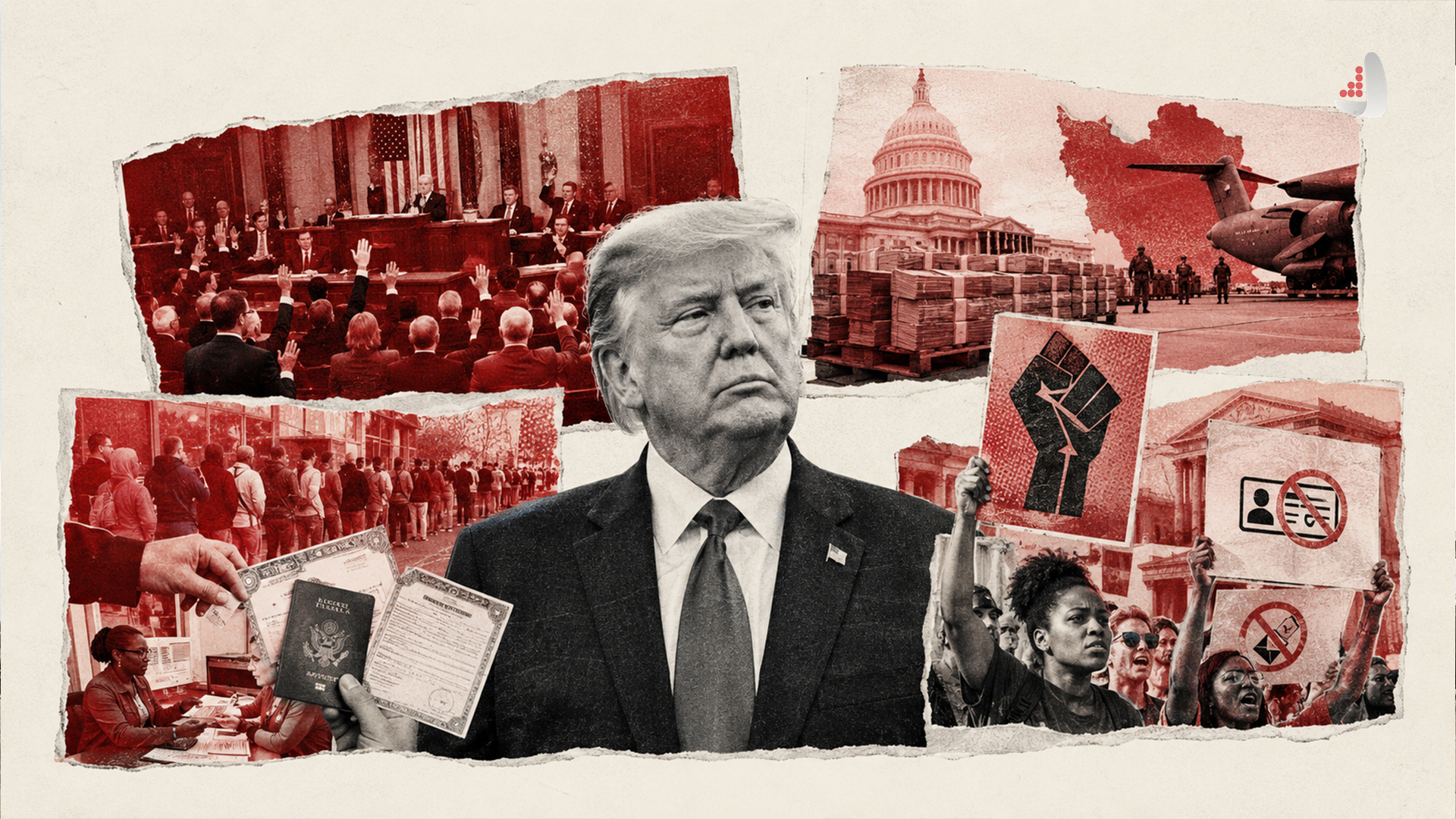
House Republicans are trying to attach parts of the SAVE America bill to a $95 billion package for the Iran war and farm aid, turning a fight over voting rules into a broader battle over war funding, election security, and Donald Trump’s political strategy.
The U.S. House of Representatives moved forward this week with a sharply contested $95 billion Republican budget framework that would help fund the war with Iran, provide new financial assistance to American farmers, and advance parts of a controversial election bill backed by President Donald Trump.
The package is not simply a routine spending measure. Republicans are attempting to use the budget process to push through parts of the SAVE America bill, a voting proposal that has already faced unified Democratic opposition and resistance from some Republicans. By attaching the measure to a larger fiscal package, GOP leaders are seeking a path that could avoid the Senate’s 60-vote filibuster threshold and move the bill with a simple majority.
That linkage has turned the proposal into a major political flashpoint. Democrats argue that Republicans are using urgent war funding and farm aid to advance new voting restrictions. Trump and his allies, meanwhile, frame the bill as a necessary measure to protect election integrity and prevent noncitizens from voting in federal elections.
What the SAVE America bill would do
The bill’s formal title is the Safeguard American Voter Eligibility Act, commonly referred to as the SAVE America Act. It remains a proposed voting bill backed by Trump and House Republicans. Its stated purpose is to require documentary proof of U.S. citizenship when people register to vote in federal elections or update their voter registration information.
Under the proposal, voters would need to provide documents such as a U.S. passport, birth certificate, naturalization papers, or similar proof of citizenship. Critics argue that a driver’s license would not be enough in many cases because it does not necessarily establish citizenship status.
Republicans say the requirement would strengthen public confidence in elections and ensure that only eligible citizens can register and vote. Opponents counter that federal law already bars noncitizens from voting in federal elections and that documented cases of noncitizen voting are extremely rare.
Why Republicans are linking it to the Iran war budget
Republican leaders know that the voting bill faces serious obstacles as a standalone measure. Democrats oppose it almost unanimously, and some Republicans have raised concerns about implementation costs, rural voters, and the effect on mail registration.
That is why GOP lawmakers are trying to fold parts of the proposal into a broader budget package that also includes funding for the war with Iran and aid for farmers affected by Trump’s trade policies. The strategy gives the bill a better chance of moving through Congress while forcing Democrats to vote on a package that combines national security, farm relief, and election rules.
For Trump, the move carries clear political benefits. A Democratic vote against the package can be framed by Republicans as opposition to war funding or farm support. At the same time, Trump can present the voting proposal not as a narrow partisan measure, but as part of a larger national-security and fiscal agenda.
Democratic concerns: election security or voter suppression?
Democrats and voting-rights groups argue that the bill’s real impact would fall on eligible citizens, not on noncitizens. The Brennan Center for Justice has estimated that more than 21 million voting-age U.S. citizens do not have easy access to documents that would satisfy proof-of-citizenship requirements.
The burden could be especially heavy for elderly voters, young people, low-income citizens, rural residents, people of color, and married women who changed their names. For many of these voters, obtaining a passport, birth certificate, or other required document can involve time, cost, travel, and bureaucratic hurdles.
The issue does not apply only to first-time registration. Voters who move, change their party registration, or update their information could also be required to provide documentation again. Critics warn that this could discourage participation among citizens who are already registered and legally eligible to vote.
Mail and online registration could face new barriers
One of the most disputed parts of the bill concerns its effect on mail and online voter registration. Many states allow citizens to register by mail or through online systems. A requirement to present documentary proof of citizenship could weaken the accessibility of both methods.
Opponents argue that if voters who register by mail must later appear in person at an election office to provide citizenship documents, the practical benefit of mail registration is greatly reduced. This could be especially difficult for voters in rural areas who live far from election offices or lack flexible transportation.
The bill also leaves questions about how documentary proof would be submitted and verified online. Without clear federal guidance, election officials across different states and counties could apply the rules unevenly, creating confusion for voters and increasing the risk of inconsistent enforcement.
Voter-roll purges are another point of conflict
The SAVE America bill would also push states toward more regular reviews and removals from voter rolls. Republicans describe this as necessary to keep registration lists accurate and remove ineligible voters. Democrats warn that aggressive purges based on flawed data can mistakenly remove eligible citizens.
Past experience has shown that government databases are not always precise. Name changes, address changes, clerical errors, outdated records, and similar names can all trigger mistakes. When that happens, the burden often shifts to voters, who may have to prove their eligibility again before they can cast a ballot.
Critics argue that if the goal is to verify citizenship, the government should rely on existing official data and interagency checks rather than forcing millions of citizens to gather and present documents themselves.
Trump can benefit politically even if the bill fails
Trump’s insistence on the SAVE America bill is not only about whether the proposal becomes law. Even if key provisions are removed in the Senate or stripped from the budget package, the fight itself can serve Trump’s political strategy.
Since 2020, Trump has repeatedly attacked mail voting, questioned election security, and raised claims about noncitizen voting. Democratic opposition to this bill gives him another opportunity to argue that his opponents are blocking stronger election protections.
For Trump’s political base, the bill connects two powerful themes: immigration and election security. Even failure could provide new material for campaign messaging, fundraising, and attacks on Democrats ahead of future electoral battles.
The Iran war and U.S. domestic politics are now linked
The effort to attach the voting bill to Iran war funding shows how deeply foreign policy and domestic politics have become intertwined in Trump’s second term. Republicans are trying to finance the war, support farmers, pressure Democrats, and reshape election rules in a single legislative package.
For Trump, the package can serve several goals at once: funding the war effort, showing support for farmers, forcing Democrats into a difficult vote, and reviving his familiar narrative about election security. But the same strategy also carries political risk. Opponents can describe it as an attempt to use wartime urgency to change voting rules in ways that could reduce participation.
In the end, the SAVE America bill is not just about voter documents. It has become part of a larger struggle over public trust, election narratives, federal power, and partisan advantage. If enacted, it could reshape voter registration across the country. If it fails, it may still give Trump a new weapon for attacking Democrats and mobilizing his base.