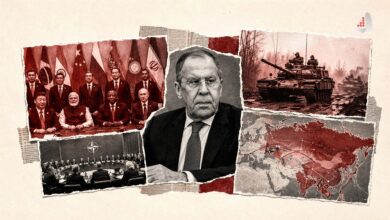
By engineering perceptions, major powers are reshaping the geopolitical balance in their favor.
According to Atlas Diplomacy, an article titled “The War of Narratives: A New Instrument of Geopolitical Competition,” written by Shirzad Askari, a media affairs expert, and published by the Strategic Council on Foreign Relations, explains how competition among powers has moved beyond the control of territory and resources to encompass the shaping of perceptions, legitimacy, and the meaning assigned to events across the media and cognitive domains. What follows is a summary of the article.
Power in global politics is no longer measured solely by the number of military personnel, the size of a country’s territory, the scale of its economy, or its deterrence capabilities. Alongside these traditional components, the ability to shape public perceptions and define the meaning of events has emerged as a major source of power. Competition among states now concerns not only what happens on the ground, but also which narrative of those events ultimately takes root in the minds of domestic and international audiences.
International media outlets, social networks, cultural productions, sporting events, and artificial intelligence systems constitute the infrastructure of this competition. The speed at which information circulates, coupled with the capacity for content to be reproduced on a massive scale, means that a narrative can become the dominant interpretation before all the facts have come to light. In such an environment, the framing of news, the choice of language, and the decision to highlight one part of reality over another may influence public opinion and political decision-making more profoundly than the event itself.
This transformation has elevated soft power from a secondary instrument to an integral part of states’ security strategies and foreign policies. Successful narratives can enhance a government’s legitimacy, create the conditions for new coalitions, or reduce public support for sanctions and military intervention. Negative narratives, by contrast, can undermine a country’s international credibility, affect foreign investment, and deepen divisions at home.
Culture, too, plays a quiet but enduring role in this arena. Cinema, literature, music, language, sports, and lifestyles can create an appealing or unfavorable image of a country and alter the attitudes of other societies without the direct application of political pressure. Global sporting competitions have likewise become stages upon which national identity, political credibility, and states’ organizational capabilities are displayed. They can no longer be regarded as entirely separate from geopolitical competition.
The spread of artificial intelligence and recommendation algorithms has carried the war of narratives into a more complex phase. These tools can target audiences with remarkable precision, generate personalized content, and shape the flow of information according to users’ interests and reactions. As a result, even technologies that appear neutral may reproduce political, cultural, or structural biases.
These developments have also blurred the boundary between domestic and foreign policy. A narrative designed for a foreign audience may directly affect public trust, political polarization, and social behavior at home. Managing perceptions, therefore, is no longer solely the responsibility of diplomatic institutions. It requires cooperation among media, cultural, security, and technology organizations.
For the same reason, national security can no longer be understood merely as the protection of borders and physical infrastructure. Safeguarding the information environment and society’s cognitive capacity has also become an essential part of national security. Countries that lack a coherent, credible, and intelligible narrative may lose political contests even when they possess considerable economic and military power. The future balance of power will depend substantially on states’ ability to construct narratives, retain the trust of their audiences, and withstand cognitive operations. In the emerging order, control over meaning may prove as decisive as control over territory and resources.