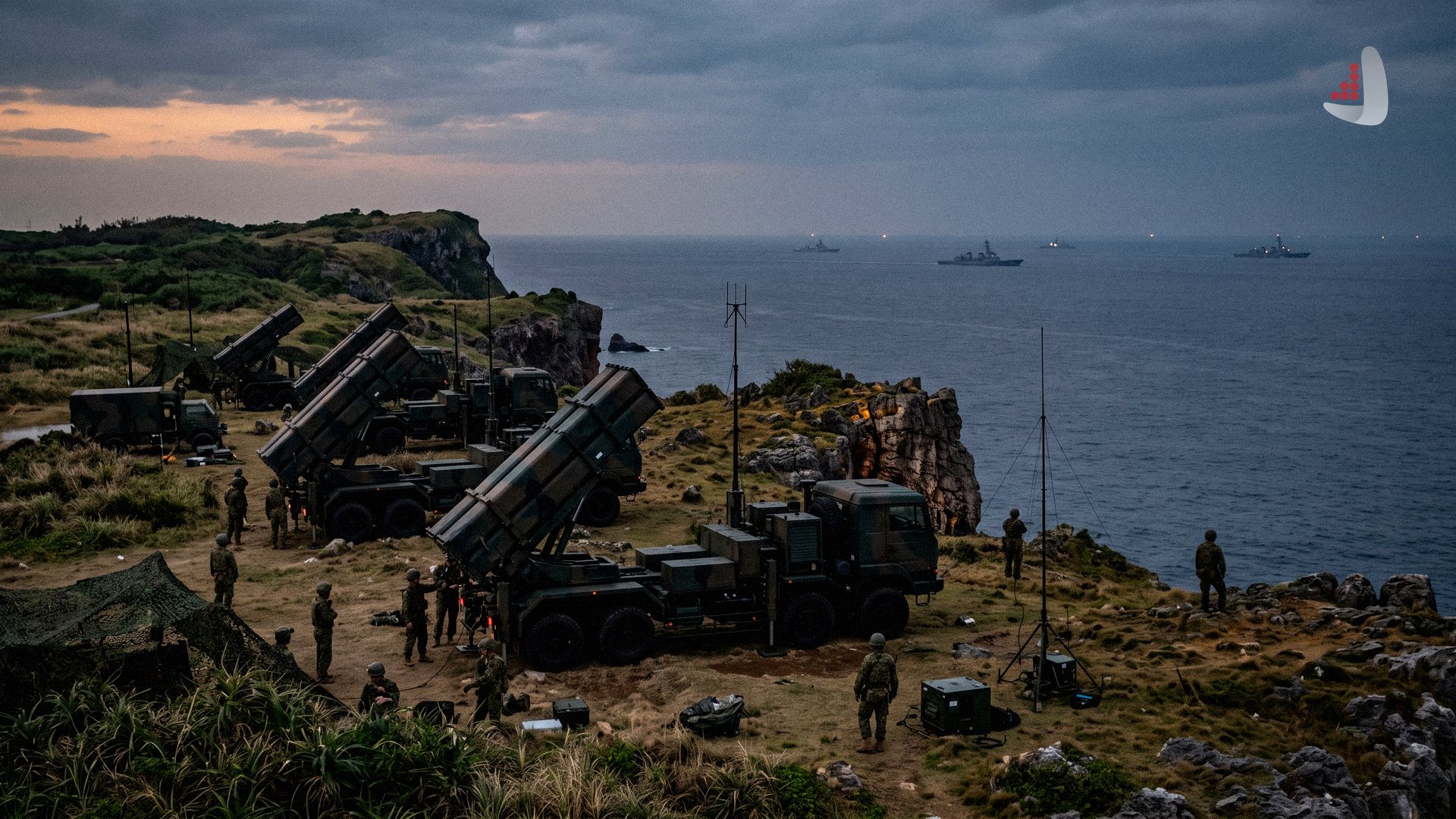
Deploying 1,000-kilometer Japanese missiles and U.S. strike systems just 110 kilometers from Taiwan reveals the offensive nature of the latest bilateral exercises.
According to Atlas Diplomacy, an opinion piece titled “U.S.-Japan Joint Drills Expose Tokyo’s Departure from Exclusive Defense” by the Global Times Editorial Board (Global Times) has been published in Global Times. The piece argues that the U.S.-Japan “Keen Sword 27” military exercise—featuring the unprecedented deployment of long-range missiles and strike systems near the Taiwan Strait—marks Tokyo’s practical abandonment of its postwar defensive posture and transforms its southwestern islands into forward offensive nodes. Below is a summary of the piece.
The U.S.-Japan joint military exercise “Keen Sword 27,” described as the largest of its kind to date, began on Monday, October 19, 2026. Although Japanese media portray the drills as a rehearsal for defending Japan’s southwestern island chain, four unprecedented developments in the exercise demonstrate that Tokyo and Washington are moving well beyond conventional defense.
First, Japan is deploying its longer-range Type 25 surface-to-ship missiles outside their base in Kumamoto Prefecture for the first time; derived from the Type 12 missile, their range has surged from roughly 200 kilometers to 1,000 kilometers, placing much of the East China Sea, parts of China’s coast, and the Korean Peninsula within reach. Second, the U.S. military is deploying its NMESIS anti-ship missile system—capable of firing precision land-attack Naval Strike Missiles—to Yonaguni Island, barely 110 kilometers from Taiwan Island, for the first time.
Third, five additional countries—France, Germany, the Netherlands, New Zealand, and the Philippines—are participating in the exercise for the first time, allowing Tokyo to wrap its expanding military role in the appearance of allied consent. Fourth, the drills are expanding beyond traditional air, missile, and ground operations into emerging domains including cyberattack response, information warfare, and electromagnetic warfare.
Rehearsing 1,000-kilometer missile strikes and stationing offensive-capable weapons 110 kilometers from Taiwan are incompatible with an “exclusively defense-oriented policy” and Japan’s pacifist constitution. With European participation largely symbolic and Washington maintaining strategic ambiguity over Taiwan, turning Japanese islands into forward launchpads on the front line of a volatile regional flashpoint neither guarantees Tokyo’s security nor promotes East Asian stability, instead placing Japan directly closer to the flames of potential conflict./ Source