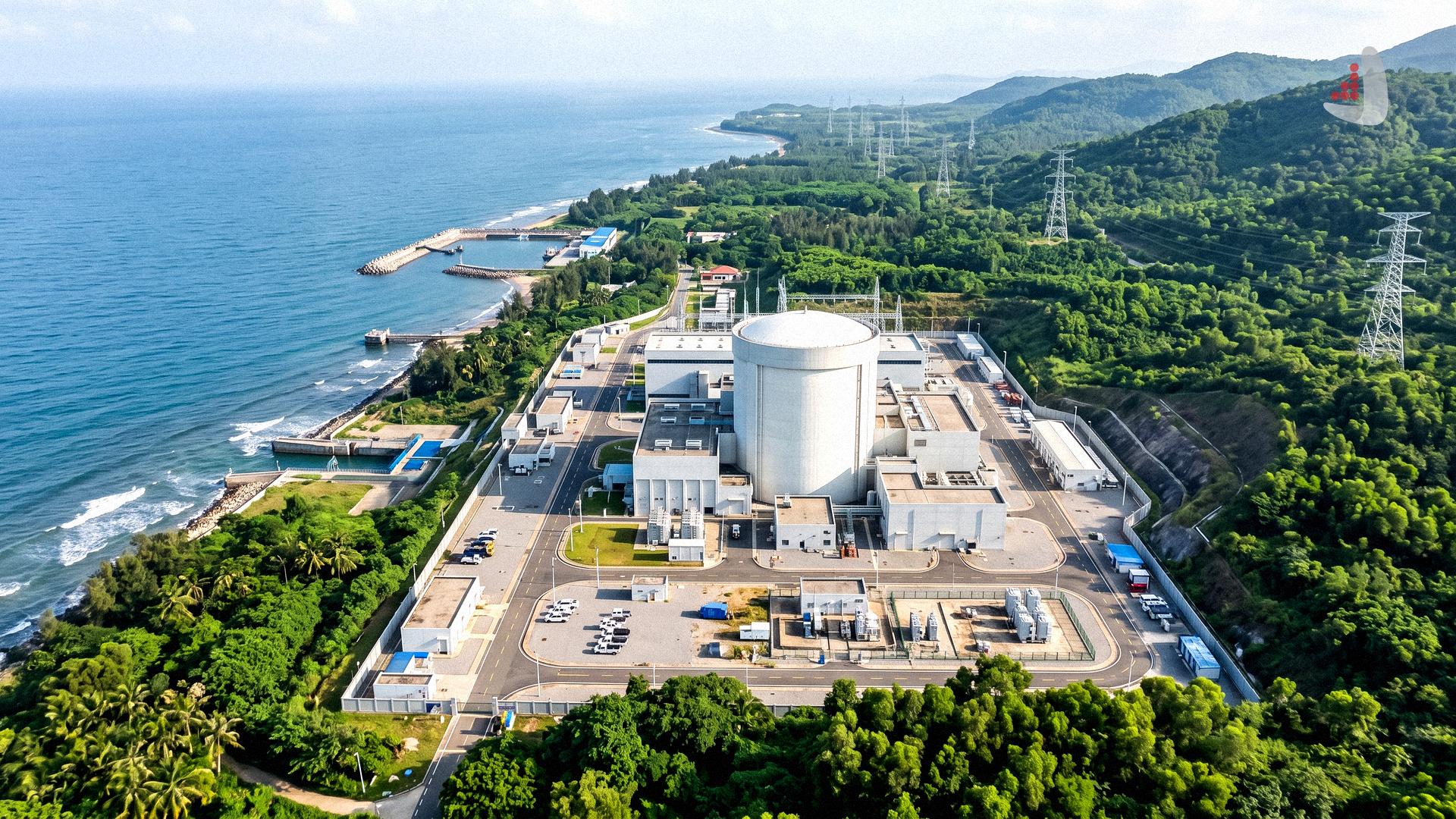
Despite China’s engineering success in building demonstration small modular reactors, high costs, grid power surpluses, and regulatory hurdles cast doubt on their large-scale commercialization.
According to Atlas Diplomacy, a research paper titled "Can China Turn Its Small Modular Reactor Ambitions into Commercial Reality?" by Tong Zhao has been published by the Carnegie Endowment for International Peace. Examining the Linglong One reactor project, the study shows that China’s rapid build-out of large nuclear power plants and renewable energy has paradoxically crowded out the domestic market for small modular reactors. Below is an abstract of the piece.
Built in just over five years in Hainan province, the 125-megawatt electric (MWe) Linglong One reactor is expected to begin operation by the end of 2026 as the world’s first commercial land-based small modular pressurized water reactor (SMR). With roughly half of the world’s reactors under construction in China and installed nuclear capacity set to surpass that of the United States by 2030, Beijing has achieved high indigenization in manufacturing major reactor components; however, turning first-of-a-kind SMR demonstration projects (ranging from 50 to 350 MWe) into standardized, economically competitive fleets faces serious hurdles.
Cost remains the primary obstacle. Chinese experts estimate that electricity generated by SMRs will be roughly 20 percent more expensive than that of conventional large reactors. Linglong One is reportedly up to twice as expensive to build per kilowatt of capacity as an average large pressurized-water reactor, with electricity costs 50 percent higher, while a high-temperature gas-cooled reactor project in Shandong province saw construction costs per kilowatt exceed twice those of a large Hualong One reactor. Moreover, in late 2025 Beijing eliminated value-added tax refunds for newly approved reactors and continues to direct state-backed financing primarily toward large gigawatt-scale plants.
Beyond cost, China’s domestic market for SMRs is uncertain. Unlike in the United States, where major tech companies are investing in SMRs to power AI data centers, China faces regional electricity surpluses driven by rapid additions of coal, renewable, and conventional nuclear capacity, prompting Beijing to site data centers in western regions with surplus green power under its "Eastern Data, Western Compute" initiative. China’s extensive ultra-high-voltage transmission grid also reduces the need for standalone SMRs in remote areas.
Under these conditions, the most promising domestic niche for Chinese SMRs lies in supplying combined electricity, industrial steam, hydrogen, desalinated water, and district heating near chemical complexes and industrial parks. Although 2025 environmental radiation rules removed the blanket requirement to site reactors at least 10 kilometers from cities of 100,000 or more and reduced the minimum planning-restricted zone for SMRs from 5 kilometers to 1 kilometer, underdeveloped cross-sector safety regulations between nuclear and chemical authorities, bottlenecks in scaling high-assay low-enriched uranium (HALEU) fuel enriched between 5 and 20 percent, spent-fuel reprocessing challenges, and local public opposition (NIMBYism) mean that commercialization will remain a gradual, selective process./ Source