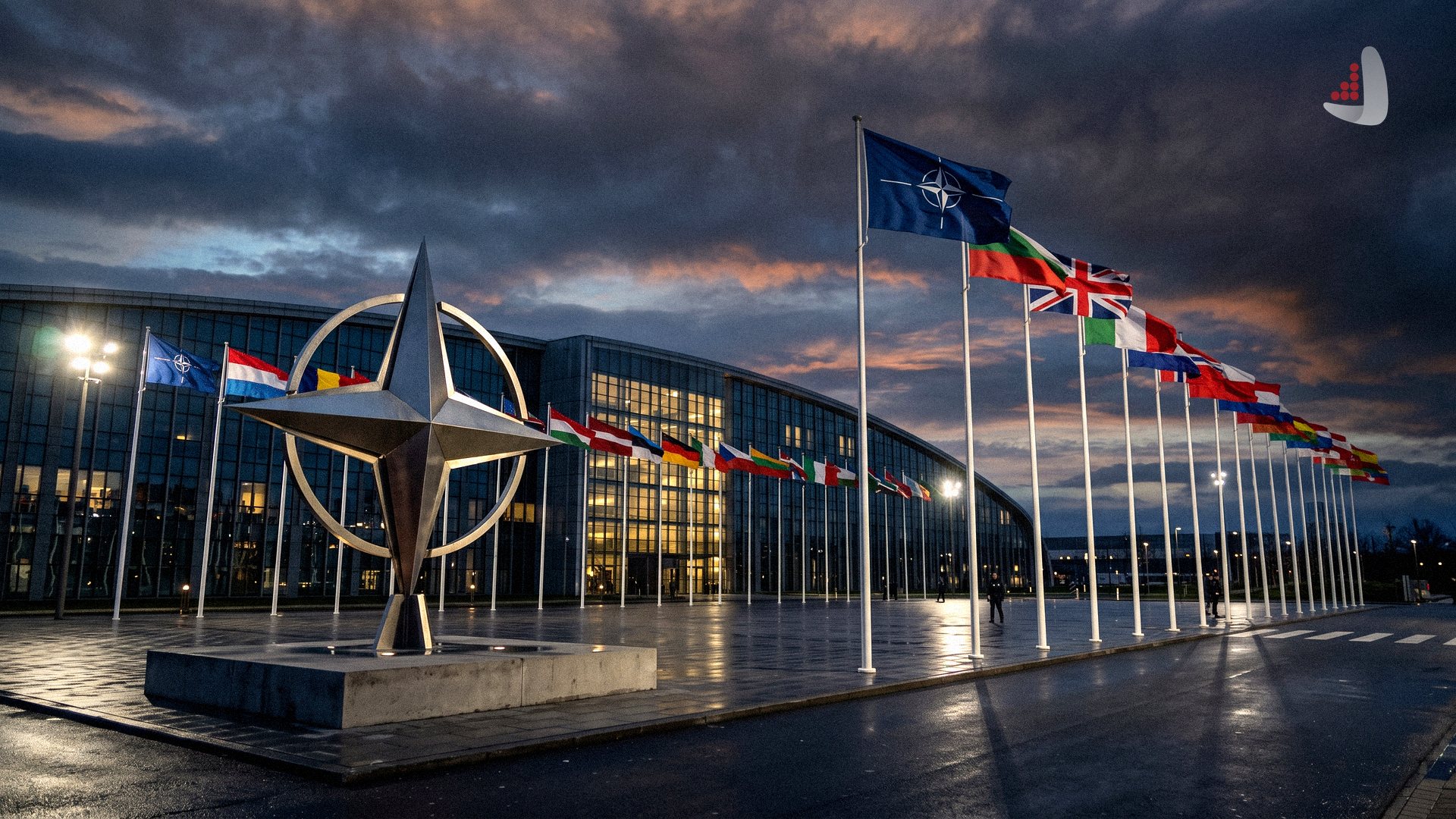
The United States wants to offload the financial and security burden of defending Europe onto its allies without sharing decision-making power.
According to Atlas Diplomacy, an opinion piece titled “Washington’s NATO Dilemma: America’s Struggle to Maintain Hegemony at a Lower Cost” by Sun Chenghao has been published in Global Times. The piece argues that American anxiety over perceived global retrenchment stems from an internal contradiction in Washington’s strategy, which seeks to shift NATO’s defense costs onto Europe while retaining undisputed alliance leadership. Below is a summary of the piece.
Some U.S. media outlets recently warned that America is “on the run”—pointing to the redeployment of U.S. bombers stationed in the UK amid security threats, the loss of military aircraft in overseas operations, and Houthi strikes on King Khalid International Airport in Riyadh—while cautioning that relinquishing NATO leadership would be catastrophic. In reality, Washington has no intention of giving up its global influence; rather, facing mounting cost pressures and military drain in the Middle East, it is increasingly reluctant to pay the full bill for dominance.
This year’s U.S. National Defense Strategy promotes the concept of “NATO 3.0,” under which European allies must assume primary responsibility for conventional defense in Europe while the United States provides critical but more limited support. The core problem is that increased defense budgets take years to translate into operational capabilities, and if Washington shortens the handover timeline to lighten its own load, Europe will be forced to absorb the security risks of unfilled capability gaps.
The central challenge in recalibrating transatlantic relations lies in how power will be distributed once Europe shoulders heavier burdens. Decisions over where additional European defense funds are directed, from whom weapons are procured, and which security priorities take precedence bear directly on European states’ national interests. Washington’s insistence on higher allied spending without accepting greater European autonomy will fuel future friction.
By using force posture adjustments as a tool to pressure allies, Washington has signaled to Europe that U.S. security commitments are up for renegotiation at every turn. In response to this uncertainty, the European Union is advancing frameworks for joint procurement and domestic defense-industrial capacity. Washington now faces an inescapable dilemma: if Europe’s capabilities remain weak, the U.S. cannot truly offload its burden; if Europe grows stronger, it will no longer maintain its past deference to Washington’s demands./ Source