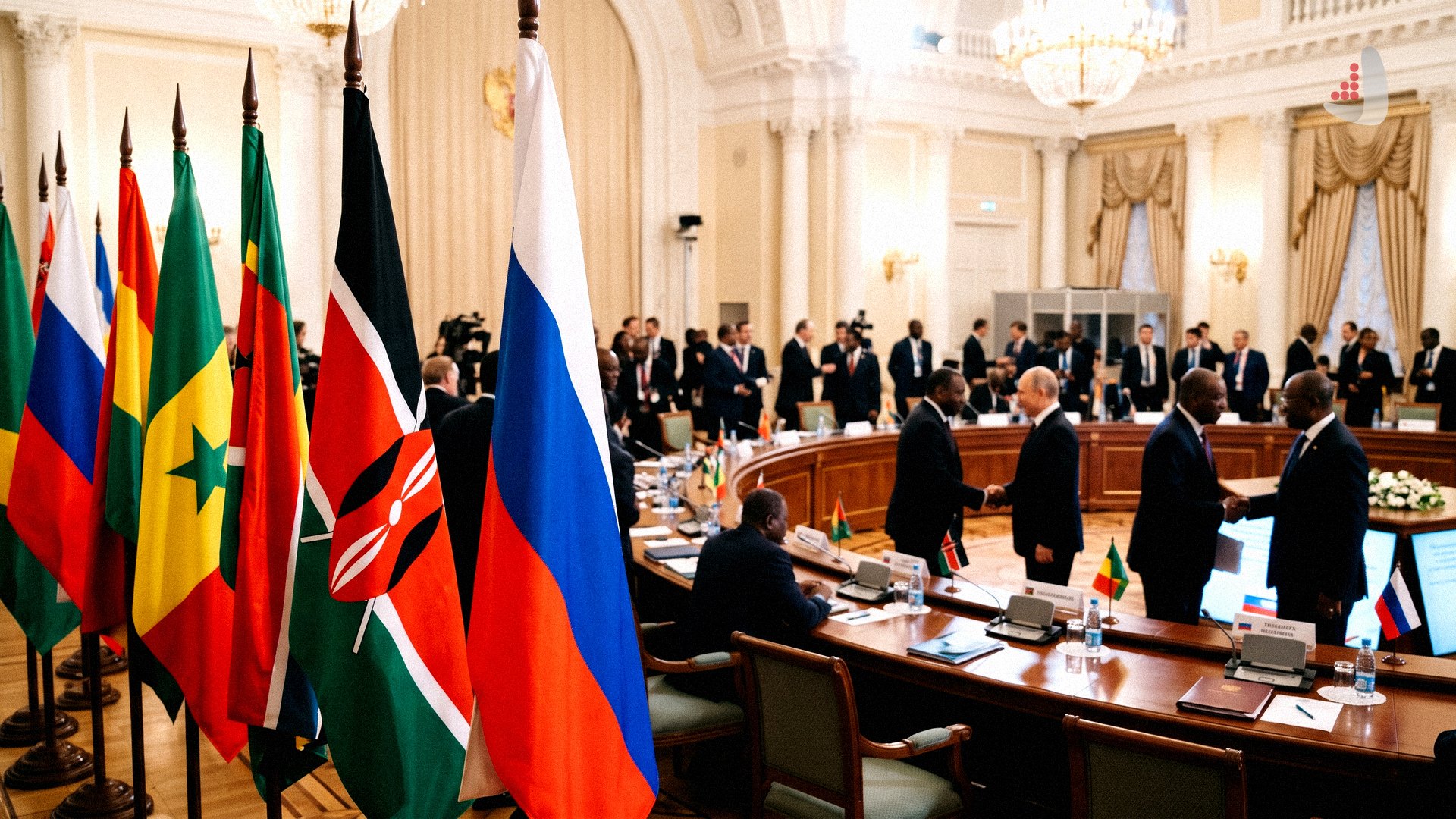
Ahead of the third Russia-Africa Summit, Moscow is focusing on financial infrastructure, food security, nuclear energy, and transferring sovereignty technologies across the African continent.
According to Atlas Diplomacy, an analysis titled “The 2026 Russia-Africa Summit: Transitioning from Symbolic Diplomacy to Strategic Mechanisms” by Nikolay Golovko has been published by RT. Ahead of the third Russia-Africa Summit in Moscow, this analysis examines the evolution of bilateral ties from 2019 to 2026, showing how Moscow is expanding its diplomatic network and leveraging its comparative advantages to cement an enduring institutional and economic presence in Africa. Below is a summary of the piece.
The third Russia-Africa Summit, taking place in Moscow on October 28–29, 2026, provides an opportunity to evaluate seven years of the Kremlin’s African policy since the inaugural summit in Sochi (2019) and the second summit in St. Petersburg (2023). The gathering will review the outcomes of the 2023–2026 Russia-Africa Partnership Forum Action Plan—which comprises 181 points spanning politics, security, trade, energy, agriculture, and technology—and adopt a new Action Plan for 2027–2029. Since 2022, Africa has shifted from a peripheral topic to a high-priority pillar of Russia’s diplomacy, foreign trade, and international coordination.
On the diplomatic front, Russia has reduced its reliance on leader-level summits by establishing a dedicated Department for Partnership with Africa within its Foreign Ministry and holding regular ministerial conferences in Sochi (2024) and Cairo (2025). Currently, 45 Russian embassies operate across African nations; since 2023, Moscow has reopened embassies in Burkina Faso, Equatorial Guinea, Niger, and Sierra Leone, inaugurated a new embassy in South Sudan, and placed the opening of missions in the Gambia, Liberia, Togo, and the Comoros on its upcoming agenda.
Economically, bilateral trade turnover grew from $16.8 billion in 2019 to $27.1 billion in 2025. However, a sharp trade imbalance persists: in 2025, Russian exports accounted for $22.7 billion while imports from Africa stood at only $4.4 billion, with roughly 70 percent of total trade concentrated in North Africa. By comparison, China-Africa trade reached $348 billion in 2025. Operating with more limited financial resources, Moscow is concentrating on sectors where it holds technological and competitive advantages—such as delivering 200,000 tons of free grain worth $60 million directly to six African nations in 2024 without international intermediaries, constructing the El Dabaa Nuclear Power Plant in Egypt, and training tens of thousands of African students in Russian universities.
As 50 of the 54 signatory states have ratified the African Continental Free Trade Area (AfCFTA) with the goal of phasing out tariffs on 90 percent of product categories, African governments are actively diversifying their external partners and pursuing industrialization under the African Union’s “Agenda 2063.” In alignment with these goals, Moscow is prioritizing the transfer of “instruments of sovereignty”—including food reserve systems, data localization, satellite communications, geological exploration, and domestic raw-material processing—to build a sustainable, long-term presence across key African markets and the Sahel./ Source