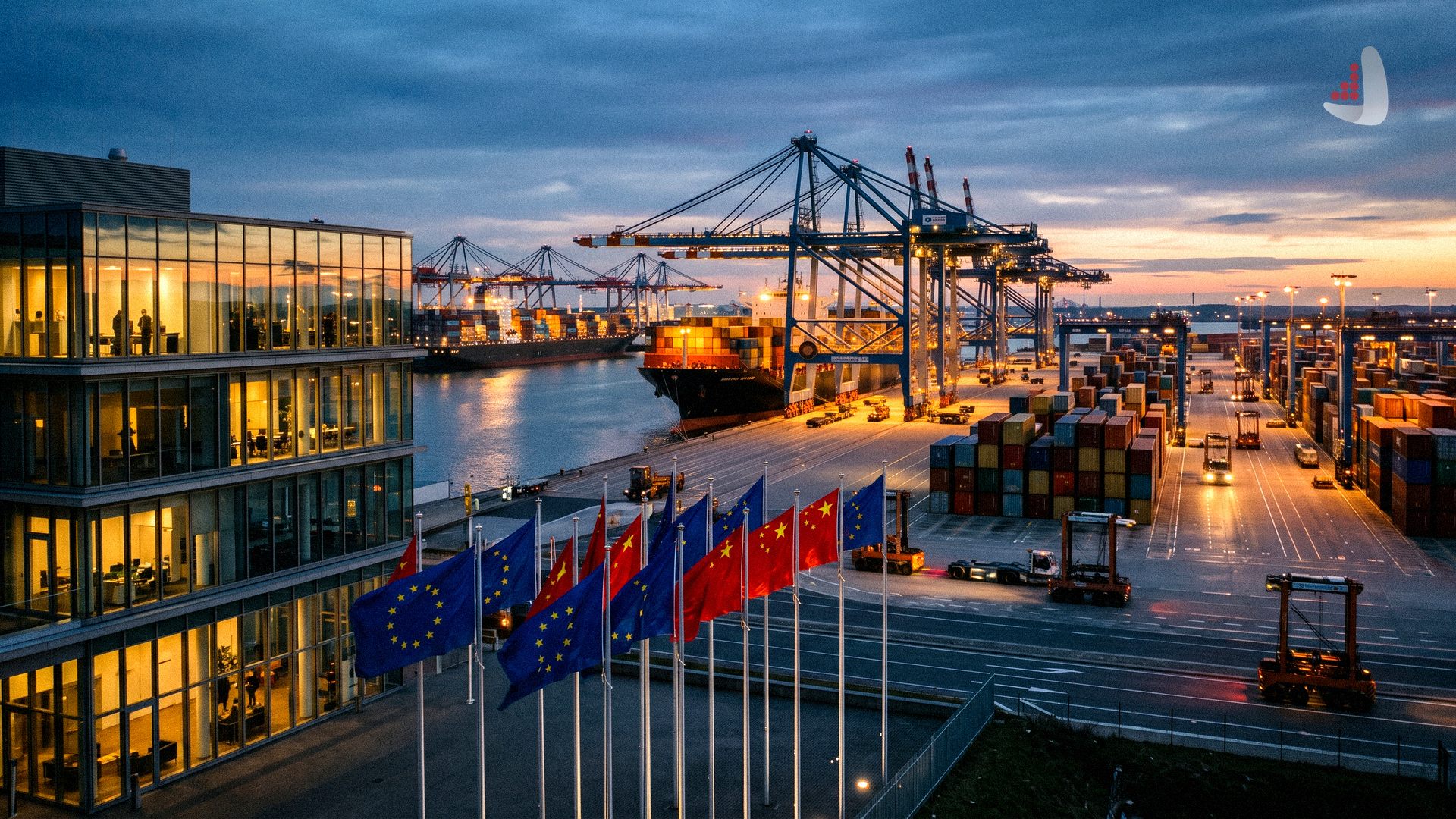
The European Union’s protectionist policies against Chinese imports neither resolve Europe’s structural economic woes nor secure lasting security guarantees from the United States.
According to Atlas Diplomacy, a commentary titled “Europe’s Strategic Miscalculation in Confronting China to Appease Washington” by Xiong Rui and Wang Shuo has been published in the Global Times. The authors argue that Brussels’ confrontational posture toward Beijing stems from anxiety over economic decline and security dependence on the United States, but sacrificing cooperation with China will not fix Europe’s internal structural problems. Below is a summary of the piece.
As the European Union considers expanding restrictions on Chinese imports, Western political and media circles are once again pushing the narrative of “getting tough on China.” Rather than representing a rational response to trade issues, this posture reflects Europe’s deep-seated anxiety over its declining relative economic weight and its inability to resolve domestic structural headwinds. Europe’s economy remains bogged down by high energy costs, chronic underinvestment, market fragmentation, and sluggish growth momentum.
Europe now finds itself caught in a double squeeze: Chinese firms are gaining ground in Europe’s traditional industrial strongholds, while the United States uses industrial subsidies and policies to draw global capital, factories, and jobs away from the European continent. Because tackling domestic structural reforms and dismantling entrenched interest barriers require immense political capital, certain European politicians prefer to scapegoat a “China shock” to appease voters and domestic interest groups while evading responsibility for their own governance shortcomings.
In the calculations of some European strategists, adopting a hard line on Beijing serves a dual purpose: domestically, it satisfies protectionist demands under the banner of economic security, and externally, it creates common ground with Washington to prove Europe’s strategic value in exchange for US security guarantees. Yet the fatal flaw in this strategy is that temporary alignment between Brussels and Washington against Beijing cannot paper over deep transatlantic divergences over tariffs, industrial policy, and defense burden-sharing.
Moreover, Washington manages its relations with Beijing according to its own geopolitical calculus, maintaining room for engagement and deal-making even as Europe escalates pressure on China. Blindly sacrificing economic cooperation with China merely to demonstrate loyalty to Washington will not secure firm security commitments in return; instead, it risks depriving European businesses of vital market access and supply-chain synergies while driving up production and green-transition costs. Achieving genuine strategic autonomy requires Europe to focus on domestic reforms and maintain a balanced relationship with Beijing grounded in mutual respect and shared long-term interests./ Source