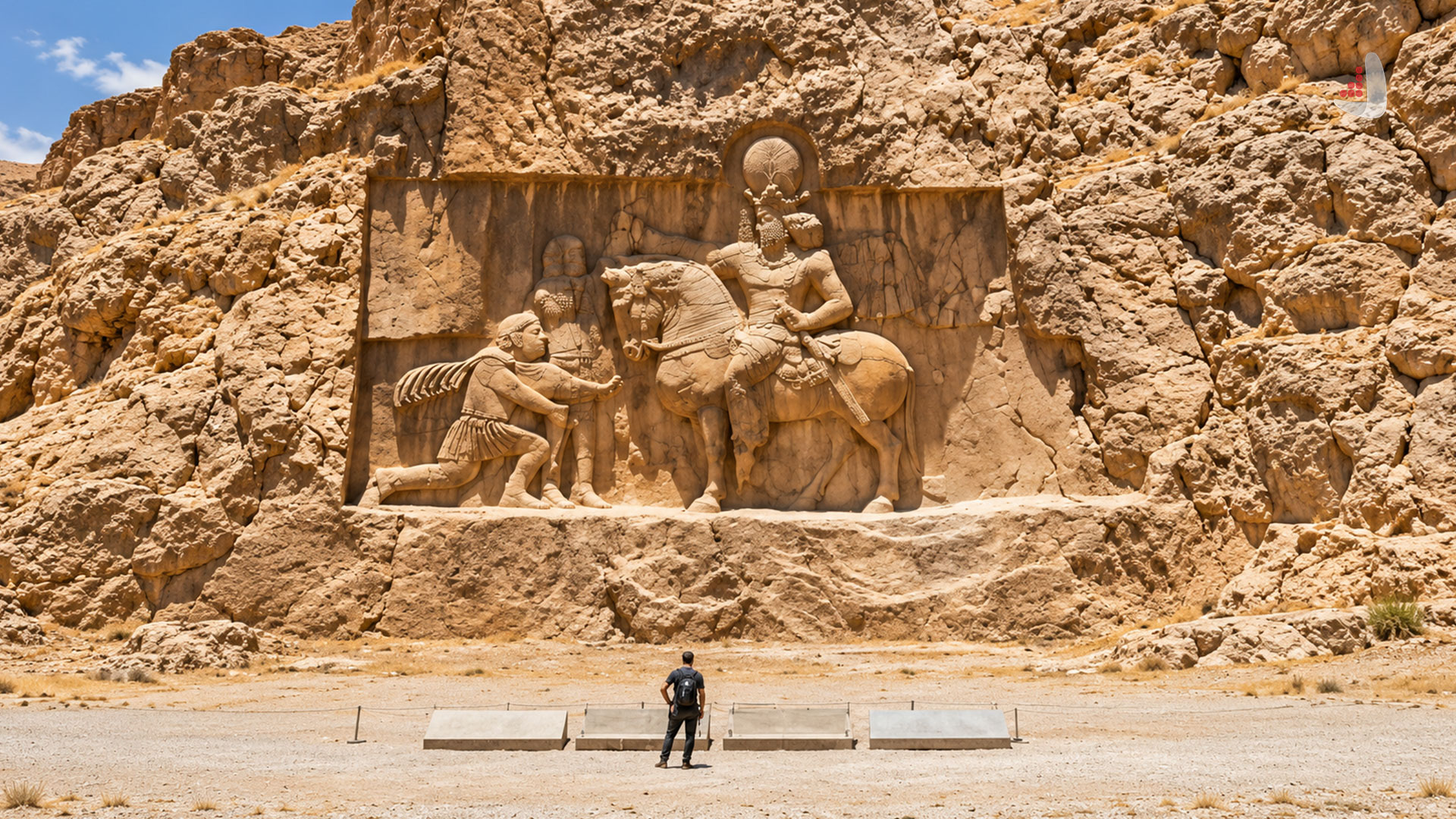
The selective narratives of history—from Cyrus the Peacemaker to Xerxes the Warmonger—serve to construct identity and to define today’s friends and enemies.
States have always drawn on history to justify friendship and enmity and to prepare public opinion in line with their own political interests. For statesmen, the past is not merely a collection of bygone events; it is a resource for constructing identity, defining ally and enemy, and legitimizing the policies of the present. Now and then, a historical figure becomes a symbol of friendship and coexistence; at other times, that same history—by foregrounding a different narrative—is deployed to represent threat and confrontation. What matters is why, at different junctures, certain parts of history are highlighted while others are dimmed—and what relation this selection bears to the political needs of the hour.
Cyrus and Esther: Two Narratives of a Single Relationship
The history of Iran–Israel relations is an instructive case for examining this question. During a period when Israel was locked in serious confrontation with the Arab states, the narrative of the Jews’ liberation from Babylonian captivity at the hands of Cyrus the Great assumed a prominent place in representations of the historical bond between Iranians and Jews. In Jewish tradition, Cyrus is the king who, after the conquest of Babylon, permitted the Jews to return to Jerusalem and rebuild the Temple. This very narrative has instilled a positive image of the Achaemenid monarch in Jewish historical memory. In contemporary political relations, too, this image has had the capacity to become a symbol of the historical friendship between Iran and the Jews—a narrative that could have emphasized the difference between the historical ties of Iran and the Jews, on the one hand, and the Israeli–Arab conflict, on the other.
Of course, Cyrus’s significance in Jewish tradition is not merely a construct of contemporary politics. The roots of this image reach back to religious texts and the historical developments of antiquity. In the Book of Isaiah, Cyrus is called “the Lord’s anointed” [Heb. mashiach, Messiah]. The matter begins at the point where a historical narrative, suited to the conditions of the day, is severed from its original context and turned into an instrument for giving meaning to political relations. In other words, the existence of a genuine historical background does not necessarily mean that its present-day political use is likewise independent of political calculation. From this vantage point, Cyrus is not simply a historical figure; he is an image onto which political actors can project their intended message by emphasizing particular facets of it.
As regional alignments shift and the confrontation between Israel and Iran intensifies, other narratives from ancient history have also acquired the potential to come to the fore. The story of Esther and Mordechai is one such example. In the narrative of the Book of Esther, Haman—who wields influence at Xerxes’s court—plots to annihilate the Jews, and Esther, by interceding with the king, prevents the plan from being carried out. This story has been present in Jewish tradition for centuries, and its origins should not be attributed to the political developments of recent years. What matters here is the possibility of its political rereading under new conditions—particularly when confrontation with Iran is framed in historical and civilizational terms. In such an atmosphere, the past can become a ground for representing enmity and threat.
In all this, one must distinguish between historical narrative, religious tradition, and political reality. The story of Esther is not, in itself, a document proving perpetual enmity between Iranians and Jews. Many scholars regard the Book of Esther as a work bearing the coloring of story and legend, whose figures—such as Haman—do not appear in documented historical sources. Just as the narrative of Cyrus, on its own, cannot explain the entire arc of Iran–Jews relations. Yet politics does not necessarily seek to present a comprehensive picture of the past. Sometimes one part of history is chosen to highlight bonds; at other times, another narrative is used to emphasize confrontation.
Xerxes in Athens: History as Today’s Weapon
Marco Rubio’s remarks in Athens on October 7, 2026, offer another example of the importance of history in the framing of political identity. In his speech on Pnyx Hill, with the Acropolis in the background, the U.S. Secretary of State referred to Xerxes’s expedition in 480 BCE, the assault of the Iranian host on Athens, and the destruction of its temples. He then linked the heritage of ancient Greece to the civilizational identity of the West and spoke of the need to revive national power, strengthen defensive capacity, and solidify the alliance between the United States and Europe. In this speech, the history of ancient Greece was not merely a subject for recalling the past; it became a basis for explaining the shared identity of the West and the necessity of reinforcing its power in today’s world.
What is noteworthy is that Rubio used the memory of the Greco-Persian Wars to paint a picture of the West’s past in which the Greeks’ stand against the Iranian host occupies a prominent place. When this narrative is placed alongside an emphasis on the need to strengthen Western power and confront today’s threats, it can help shape a historical image of Iran as the West’s civilizational rival.
The coincidence of this speech with the third anniversary of the Al-Aqsa Flood operation is also noteworthy from the standpoint of political analysis—though mere coincidence is not sufficient grounds to prove a planned connection between the two events. The significance of the matter lies at a broader level: in conditions where political and security conflicts are tethered to identity and civilizational narratives, history can become an instrument for explaining the present situation and for steering audiences’ perceptions of the parties involved.
Placing these examples side by side reveals a fundamental point. In the political narration of history, sometimes Cyrus is chosen to evoke friendship, and sometimes Xerxes to foreground war. These two images are not necessarily the product of a coordinated plan or a single decision, but they show that different parts of the past can take on different political functions under different conditions. A historical figure may, in one period, be a symbol of bond and coexistence, and in another, a narrative from the past may be employed to highlight difference and confrontation.
The principal question, therefore, is not only what happened in the past, but also who, at what time, and with what aim brings a particular part of that past to the center of public attention. Iran’s history is neither confined to Cyrus nor definable by Xerxes’s expedition. The Achaemenid Empire, like other great powers of history, had a complex and multifaceted past that cannot be reduced to two simple images of peace and war.
The core issue is not the defense of one king against another; it is understanding the mechanisms through which the past is pressed into the service of today’s political needs. Cyrus the Peacemaker and Xerxes the Warmonger are both part of historical memory, but which image is foregrounded at which juncture can also tell us something about the priorities and calculations of the present. In the end, understanding politics requires that, beyond examining today’s events, we attend to how the past is represented—for sometimes the struggle over the future begins, above all, on the battlefield of historical narratives.
Ali Akbar Rezaei