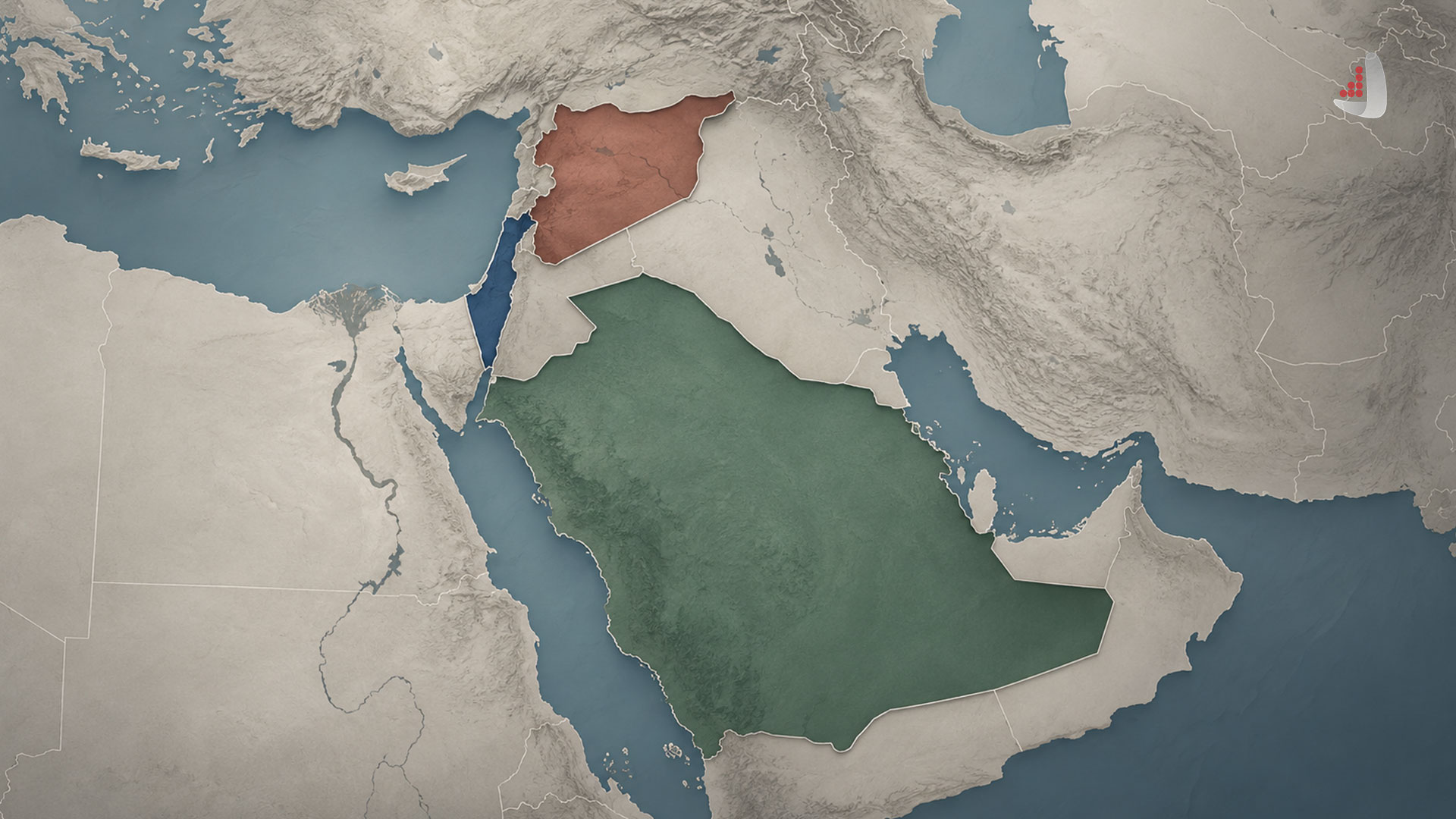
Closer ties between Damascus and Riyadh intensify regional competition and Israel’s security concerns.
According to Atlas Diplomacy, the article “Reshaping Regional Balances and Israel’s Security Dilemma,” written by Farhad Ghaderi and published by Iranian Diplomacy, examines Ahmed al-Sharaa’s visit to Saudi Arabia in the context of regional power competition and Syria’s security challenges. The analysis argues that potential Saudi support for Syria’s reconstruction and the consolidation of the Damascus government could alter the balance of Iranian and Turkish influence while creating both opportunities and concerns for Israel. The following is a summary of the article.
Ahmed al-Sharaa’s visit to Riyadh and meeting with Mohammed bin Salman aim to redefine Damascus’s regional position. Syria needs legitimacy, financing, and security capabilities. Discussions on investment, infrastructure reconstruction, and cooperation in energy, industry, and trade could help address the first two needs. Controlling armed groups remains challenging.
Saudi Arabia supports a stronger Syrian central government but does not want Damascus to fall within the exclusive sphere of influence of Iran or Turkey. Riyadh also fears smuggling, extremism, and regional insecurity. Saudi economic assistance is therefore likely to depend on investment safeguards, efforts against armed and smuggling networks, and stronger governance in Damascus. Reconstruction also shapes Syria’s political and security future.
For Damascus, closer relations with Riyadh offer an opportunity to diversify external partnerships and reduce dependence on Ankara. Turkey wields influence in Syria; Saudi Arabia seeks its own role. Syrian–Saudi rapprochement could also narrow the space for Iranian influence. Yet enduring social, economic, and security networks could preserve Tehran’s role.
Regional security considerations, including the conflict in Yemen, may shape Riyadh’s expectations of Damascus. Direct Syrian participation in another conflict would, however, be costly given the country’s economic weakness, the need to integrate armed groups, and the difficulty of consolidating central authority. Limited political, intelligence, or logistical cooperation is consequently assessed as more plausible than direct military involvement. This could preserve ties with Riyadh without drawing Syria into another confrontation.
Israel faces a security dilemma over these developments. On one hand, strengthening Syria’s central government could facilitate control over armed groups and constraints on Iranian influence. On the other, a stable Syrian state backed by Arab governments might eventually gain greater capacity to resist Israeli actions. Israel focuses on southern Syria, the Golan Heights, and border security. Damascus, meanwhile, considers Israeli military operations a violation of its sovereignty.
Ahmed al-Sharaa has raised the possibility of a security agreement with Israel, while maintaining that it would not mean relinquishing Syria’s claim to sovereignty over the Golan Heights. This exposes tensions between Israeli buffer-zone policies and Syrian sovereignty. Saudi Arabia could play a role in easing tensions or facilitating dialogue, but a rapid settlement of the territorial dispute appears unlikely. Saudi support therefore brings Israel both opportunities and concerns.
The outlook for Syrian–Saudi relations depends on Damascus’s ability to stabilize security, establish more inclusive governance, and create conditions favorable to investment. Progress could deepen economic and political cooperation. Conversely, worsening insecurity, intensified competition among external powers, or confrontation with Israel could prompt Riyadh to scale back its support. Al-Sharaa’s visit therefore signals conditional convergence rather than a settled alliance, as both governments seek to reshape regional balances. The outcome depends on Syria and regional reactions./ Source