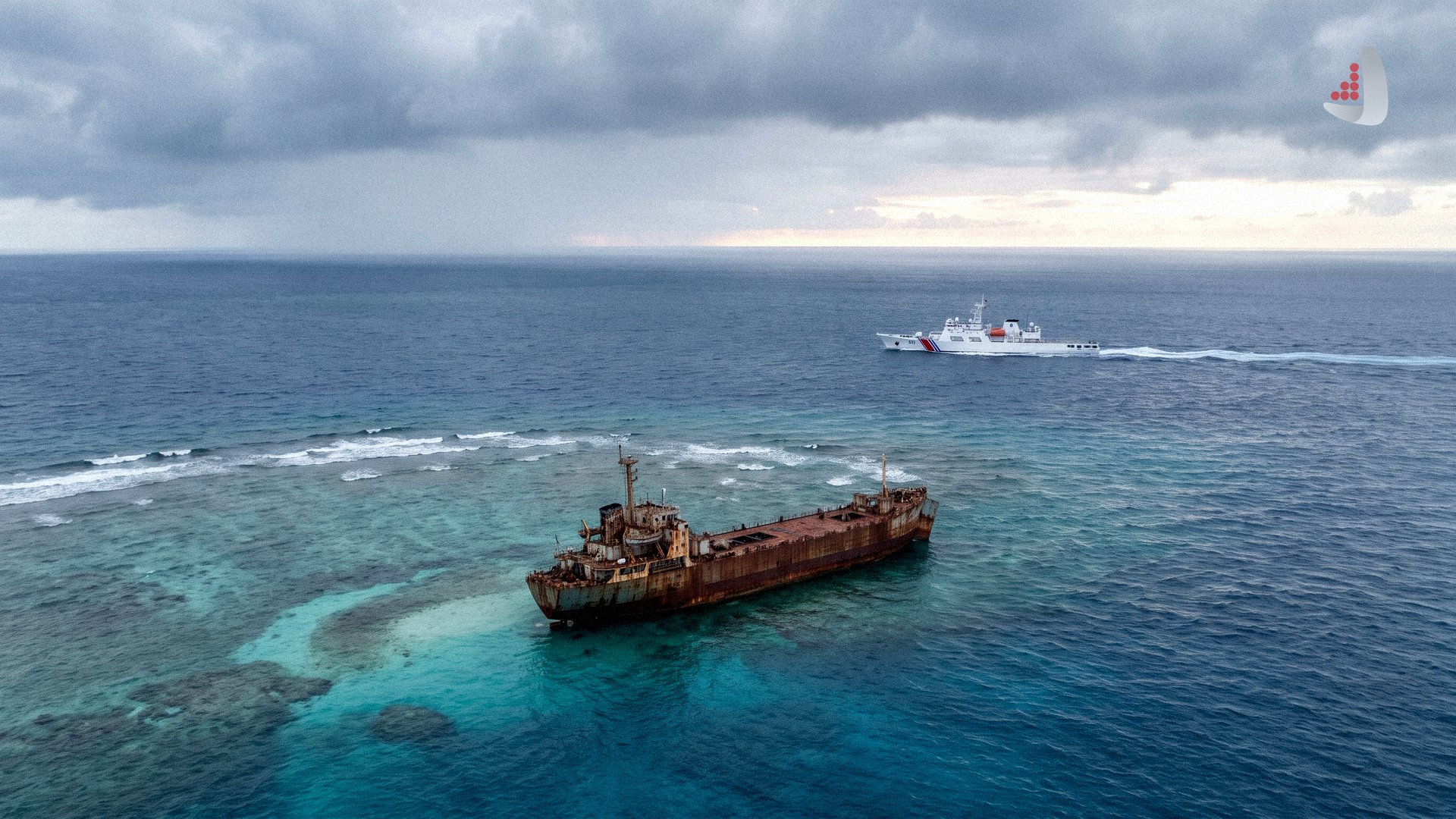
Manila's defense officials issue hollow threats and rely on a US defense treaty while ignoring the heavy costs of provoking tensions in the South China Sea.
According to Atlas Diplomacy, an opinion piece titled "Philippine Defense Chief Charges at China Behind a US Paper Shield" has been published in Global Times. Examining recent remarks by the Philippine Defense Secretary regarding the potential removal of a grounded Philippine vessel at Ren'ai Jiao, the piece argues that Manila's reliance on US military backing to intimidate Beijing is an opportunistic performance driven by domestic political ambitions. Below is an abstract of the piece.
Philippine Defense Secretary Gilberto Teodoro Jr. has once again lashed out at Beijing, claiming that if China were to remove the Philippine warship illegally grounded at Ren'ai Jiao, it would constitute an "act of war," and warning that Chinese personnel boarding the vessel could trigger the US-Philippines Mutual Defense Treaty. Yet he immediately backpedaled, clarifying that an "act of war" does not necessarily mean entering a "state of war," since only the President and Congress hold the authority to declare war.
These contradictory remarks were prompted by an unverified Philippine media report claiming that Beijing was considering 10 countermeasures against Manila, including removing the grounded ship, blocking supplies, sanctioning Philippine politicians, reducing oil and fertilizer supplies, and restricting tourism. Teodoro rushed to issue warnings while admitting he had not even read the report—behavior suggesting he knows full well the price of provoking China and Manila's inability to pay it.
Beijing maintains indisputable sovereignty over Ren'ai Jiao and its adjacent waters, and the China Coast Guard's law enforcement operations and demands for the removal of the grounded vessel are conducted in accordance with the law. Should Manila persist in provocations, illegal intrusions, and structural reinforcements at Ren'ai Jiao, or attempt to forcibly breach Chinese law-enforcement controls, China will take all necessary countermeasures to safeguard its territorial sovereignty, and hiding behind external powers will not salvage the situation.
Last month, Philippine media also reported on a letter allegedly signed by Teodoro and addressed to a CIA official, in which he pledged to strengthen the US-Philippines alliance and pursue a hardline policy against China if he assumes the presidency in the future, including manufacturing maritime friction at Ren'ai Jiao during an ASEAN foreign ministers' meeting to portray China as a bully. Although the Philippine Department of National Defense denied the letter's authenticity without providing evidence, Teodoro's conduct closely mirrors its contents, indicating that he is manufacturing friction to serve his personal political ambitions and pledge allegiance to external forces.
Attempting to intimidate Beijing with cries of an "act of war" carries grave risks for Manila. No external power will foot the bill for reckless rhetoric, and any bilateral defense treaty will prove to be nothing more than a scrap of paper in the face of a crisis of this magnitude./ Source