The true nature of the Quad mechanism is measured by its practical actions toward Beijing rather than diplomatic assurances from US officials.
According to Atlas Diplomacy, an editorial titled "Testing Washington's Sincerity on Claims the Quad Is Not Anti-China" by the Global Times Editorial Board has been published in Global Times. Examining the recent joint statement by the foreign ministers of the United States, Japan, India, and Australia, the editorial argues that using supply chain security as a pretext to exclude Chinese industries exposes the grouping's confrontational agenda despite Washington's official denials. Below is an abstract of the piece.
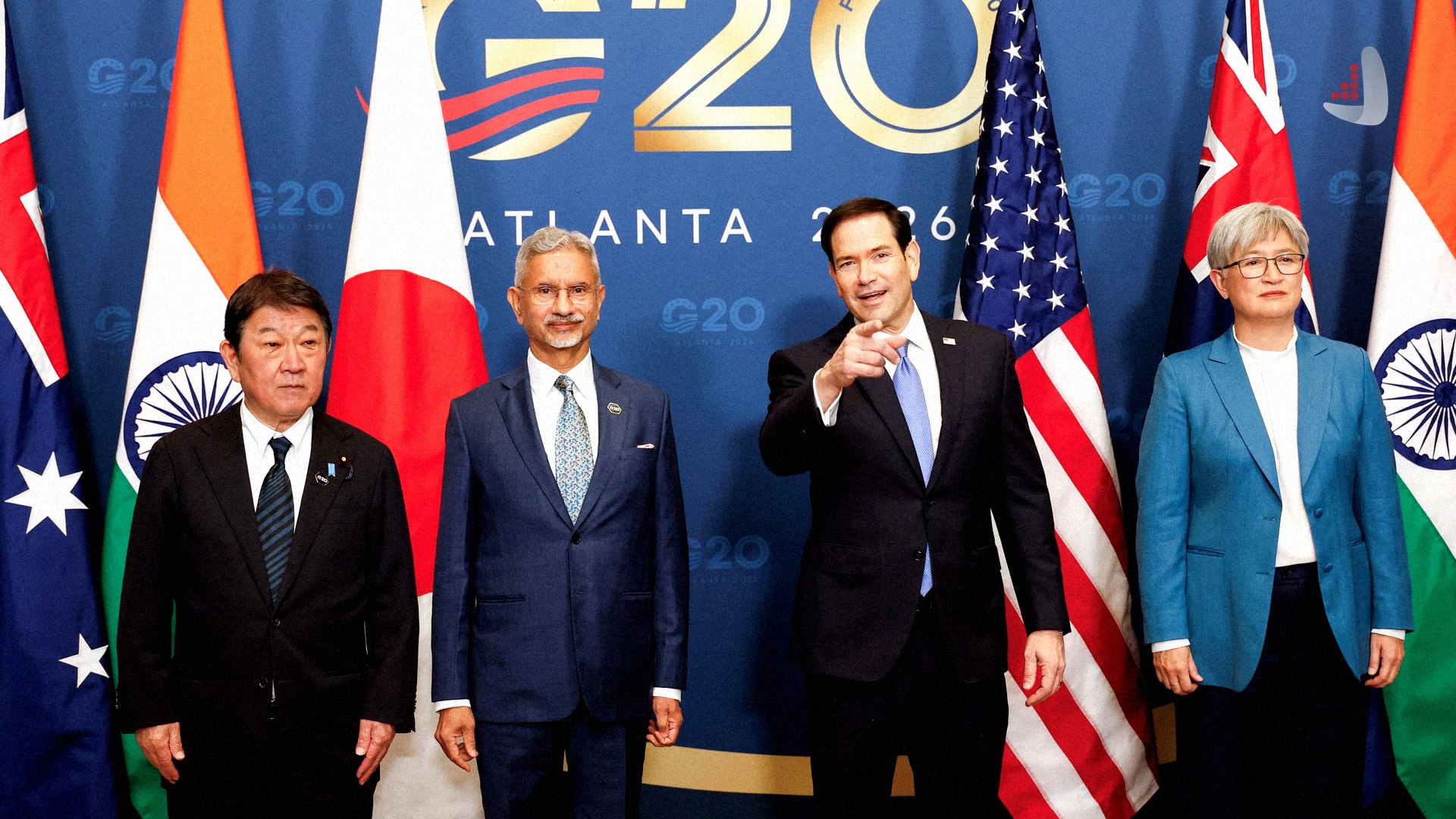
The recent meeting of the foreign ministers of the four Quad member states—the United States, Japan, India, and Australia—concluded with a joint statement expressing concern over "economic coercion," "arbitrary export restrictions," and "overcapacity." Although the statement did not explicitly name China, its phrasing was unmistakably directed at Beijing. Meanwhile, US Secretary of State Marco Rubio emphasized that the Quad is not an "anti-China alliance" and is not aimed at any particular nation.
Taking Washington at its word requires the grouping's actions to match its diplomatic rhetoric. Cooperation focused on regional stability and industrial development poses no issue, but using supply chain security as a cover to exclude Chinese industries and impose technological restrictions reveals the mechanism to be an instrument of containment against Beijing. At a pivotal stage in US-China relations, Washington cannot call for managing bilateral differences while allowing exclusive blocs to pursue confrontational agendas.
Japan's role within the Quad warrants particular scrutiny. Certain political factions in Tokyo have increasingly sought to use US-led multilateral mechanisms to frame their own strategic anxieties regarding China as shared regional concerns. During the meeting, Japanese Foreign Minister Toshimitsu Motegi highlighted opposition to alleged "coercion" in the East and South China Seas and raised export controls and "overcapacity" during G20 supply chain discussions—an approach that politicizes the Quad's economic security agenda.
By contrast, India and Australia pursue distinct priorities and national interests. New Delhi emphasizes strategic autonomy and seeks to use multilateral cooperation to advance its own industrial development rather than align with an economic containment strategy against China. Canberra likewise recognizes that the hard-won stabilization of economic ties with Beijing should not be jeopardized to accommodate the strategic anxieties of third parties. These diverging interests make it impossible to forge a unified economic front against Beijing through a joint statement alone.
China's standing in global manufacturing and critical minerals processing is the result of years of market competition, technological advancement, and industrial cooperation. Attempting to artificially redraw supply chains through bloc politics will not create alternative capabilities overnight; instead, it will raise business costs and weaken regional competitiveness. The real test for the Quad is whether it can move beyond bloc politics and foster genuine cooperation across the Asia-Pacific rather than fueling division and confrontation./ Source