Disruptions in sea lanes have once again highlighted the value of Eurasian land corridors, and Iran could become one of the key nodes in this network.
Recent disruptions along maritime routes, from the Red Sea to the Strait of Hormuz, have placed a central question before international politics: can the sea still remain the cheapest and safest pillar of global trade? The short answer is that the sea will not lose its position anytime soon. Yet the era of unquestioned reliance on maritime routes and a limited number of chokepoints is also drawing to a close. Rising geopolitical risks, insurance costs, and shipping delays, alongside the expansion of Eurasian rail and road networks, have given land corridors a renewed role. In this context, Iran could move from being a peripheral actor to becoming one of the main nodes connecting north and south, east and west—provided that it strengthens infrastructure, regulatory stability, and regional cooperation at the same time.
History shows that durable powers have rarely chosen between land and sea in absolute terms. The Achaemenids built the main foundation of their authority on control of territory and the connection of inland centers through the Royal Road and an extensive administrative network, yet they also drew on the maritime capacities of the Persian Gulf, the Red Sea, and the Mediterranean. Imperial China, too, used naval power in different eras to serve coastal security and territorial cohesion. In the Islamic world, and later in the Ottoman Empire, the endurance of power depended less on fleets than on the capacity to govern territory, control routes, and link economic centers.
This historical experience does not mean that the sea is unimportant. From the fifteenth century onward, the discovery of sea routes, the Industrial Revolution, and the emergence of the global economy gave European maritime powers, and later the United States, an unprecedented advantage. Alfred Thayer Mahan’s theory of the importance of controlling the seas and maritime chokepoints also emerged in this context. Britain, and then the United States, were able to turn maritime trade into an instrument of global influence by combining naval power, technology, ports, financial systems, and networks of allies. Yet this model depended on an environment in which the security of shipping lanes was relatively predictable and the cost of passing through chokepoints remained manageable.
That assumption is now weakening. Crises in the Red Sea and the Persian Gulf have shown that a regional confrontation can suddenly affect shipping schedules, insurance costs, delivery times, and commodity prices across several continents. In such circumstances, the issue is not merely the deployment of military fleets or the actions of one particular actor. Great-power competition, sanctions, regional conflicts, and threats to freedom of navigation all raise the economic cost of maritime trade. The more cargo owners face delays, rerouting, and steep insurance premiums, the stronger their incentive becomes to find alternative routes.
This is where a return to the ideas of Halford Mackinder becomes important—not as a fixed prediction, but as an analytical framework. In 1904, Mackinder emphasized the importance of central Eurasian space and the relationship between geography, power, and access. Today, competition over corridors likewise demonstrates that controlling a route means more than simply moving goods. It can affect supply chains, access to markets, energy security, and political bargaining power. Still, the Heartland should not be treated as a rigid model capable of explaining every geopolitical reality. Iran matters more as a link between central Eurasia, the Persian Gulf, the Caucasus, Central Asia, and West Asia: a mediating and connective role, rather than necessarily a place at the center of a classical Heartland.
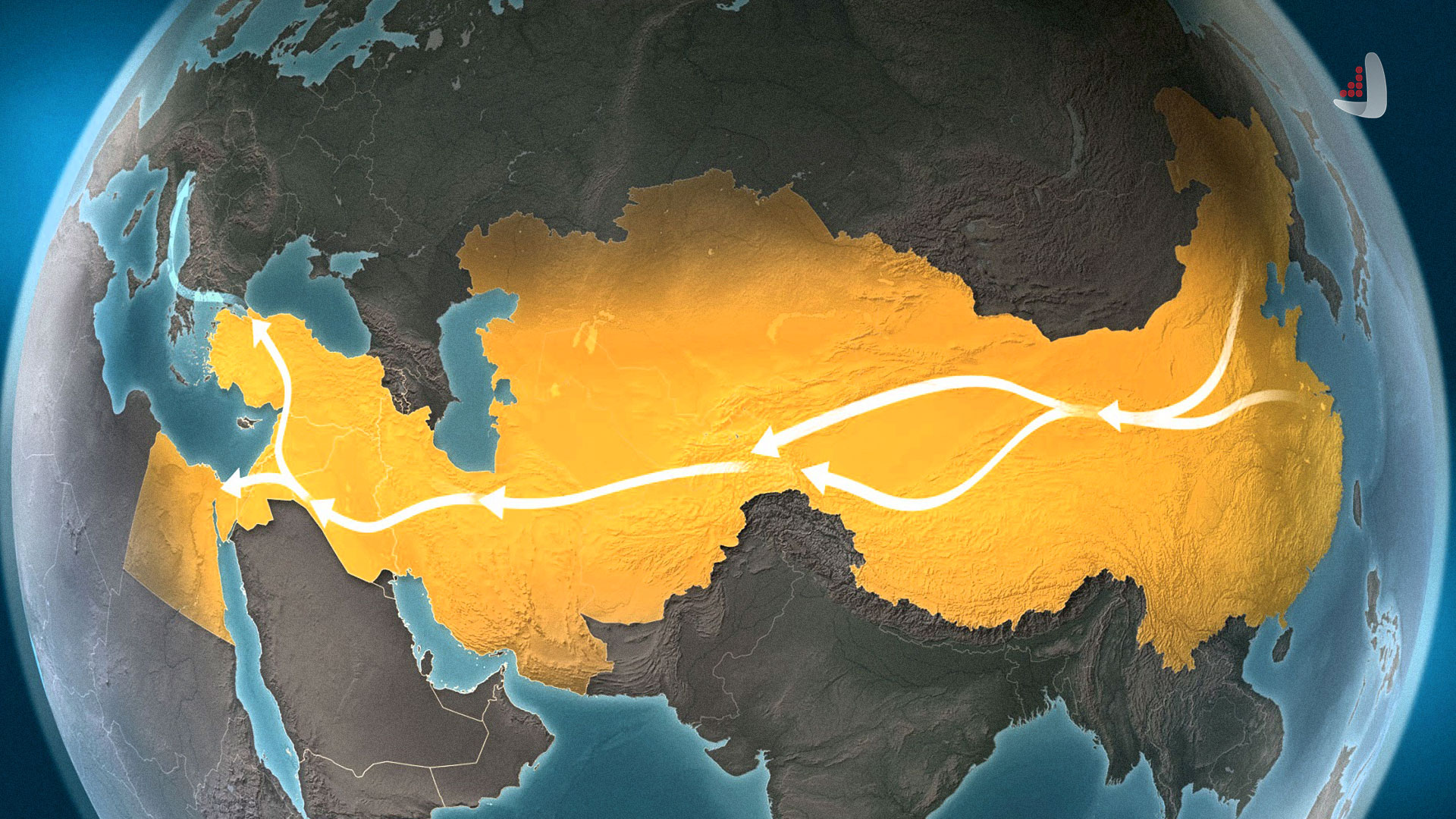
The North–South Corridor offers a clear example of this change. This route can connect Russia and neighboring countries, through Iran, to the Persian Gulf, India, and oceanic waters, reducing time and costs on certain routes compared with the traditional Suez route. East–west corridors—from China’s rail links with Central Asia and Turkey to complementary routes through the Caucasus and Pakistan—show that global trade must rely on a diversified network of alternative pathways rather than a single route if it is to reduce its vulnerability. Iran’s value in this network does not stem solely from its geography. The completion of rail lines, port capacity, customs procedures, cargo-tracking capabilities, regulatory stability, and reliable financial mechanisms will determine whether that location becomes a real economic advantage.
Some, however, argue that maritime transport will remain the main pillar of global trade because of its enormous capacity and lower cost in moving bulk goods, and that land routes cannot replace it. This objection is correct. Rail and road cannot fully substitute for the oceans, either in terms of capacity or cost. But this reality does not make land unimportant. The issue today is not the “complete replacement of the sea,” but the end of maritime monopoly. Land corridors can offer a strategic option for higher-value goods, time-sensitive cargo, and countries that are vulnerable because of their dependence on maritime routes.
If it makes prudent use of this opportunity, Iran can become one of the important centers of this diversification. Simultaneous access to the Persian Gulf and the Sea of Oman, connections with Central Asia and the Caucasus, proximity to the markets of Turkey, Iraq, Pakistan, and Afghanistan, and its location along potential north–south and east–west routes give Tehran a set of significant advantages. This advantage becomes durable only when Iran’s transit policy rests on predictability, route security, competitive costs, and cooperation with neighboring states. Using geopolitical position to increase bargaining power is understandable, but turning a corridor into a strategic asset depends above all on the trust of traders and the continuity of services.
The future of the international order, therefore, should not be explained through the simplistic image of “the decline of the sea and the rise of land.” What is taking shape is a rebalancing between the two. The sea will remain the principal artery of global trade, but land is gaining greater weight because of technology, geopolitical pressures, and states’ need for alternative routes. Iran can play an important role in this rebalancing—not as a unilateral hegemon, but as a reliable node in Eurasia’s transit, energy, and connectivity network. This is the opportunity that must be transformed from a slogan into an infrastructure program and a strategy of economic diplomacy.
Ali Rahimipour, M.A. in International Relations and Defense Management