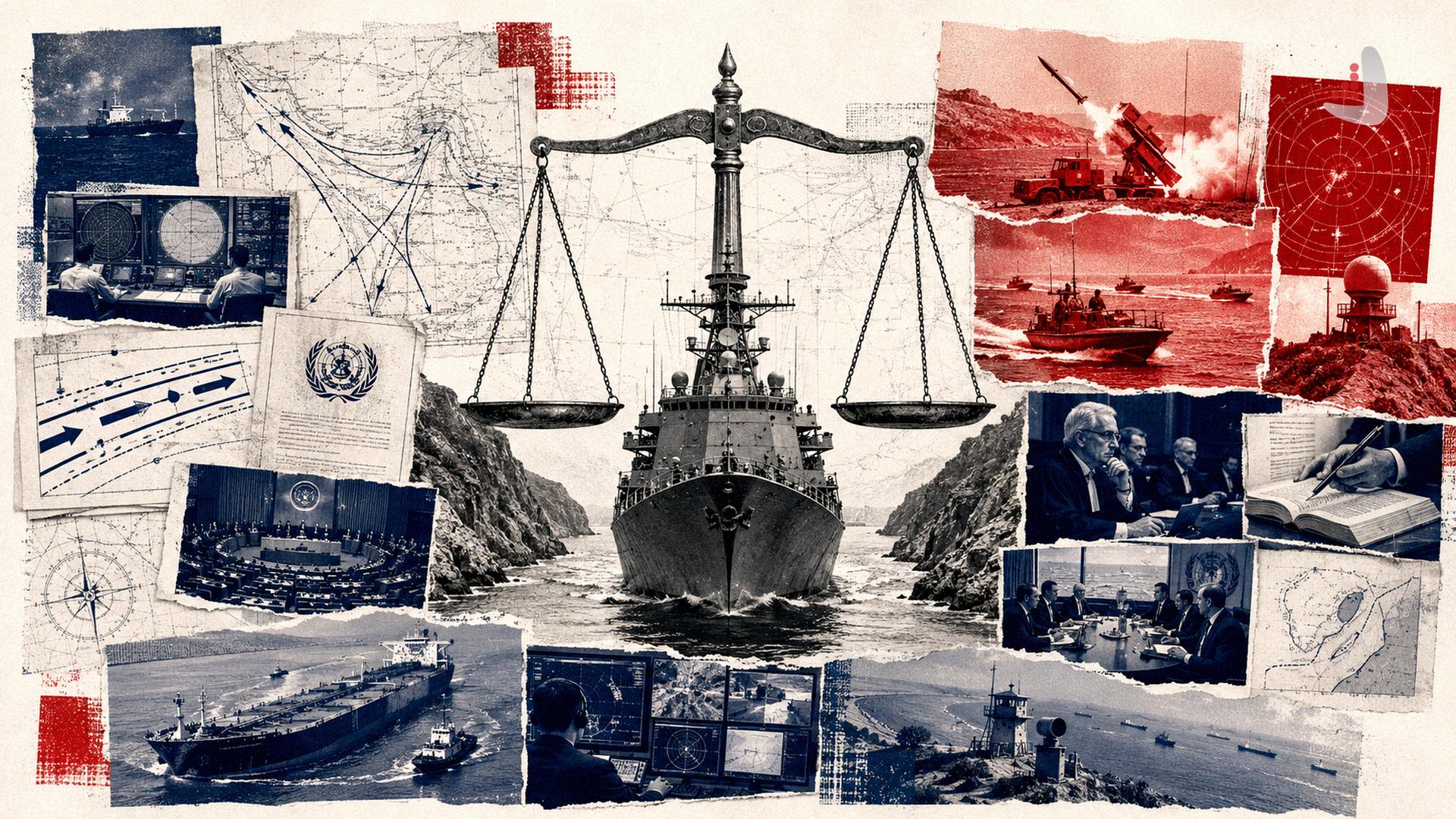
Iran’s security and freedom of navigation through the Strait of Hormuz must be balanced.
According to Atlas Diplomacy, the article “The Legal Challenge of the Strait of Hormuz,” written by Mohammad-Meysam Nadafpour and affiliated with the Research Institute of Strategic Studies, examines the tension between freedom and safety of navigation and the legitimate security interests of a coastal state. It asks whether the Strait of Hormuz’s current legal regime is capable of adapting to the Persian Gulf’s new security environment or whether new interpretations and norms are required. What follows is a summary of the article.
Traffic separation schemes are among the most important technical mechanisms in the law of the sea for reducing the risk of vessel collisions, regulating passage routes, and improving navigational safety. The current shipping lanes through the Strait of Hormuz were designed on the basis of a joint proposal submitted by Iran and Oman in the late 1960s and were approved by the International Maritime Organization in 1968. These arrangements reflected the technical and security conditions of that period, when the extent of foreign military presence, the types of weapons deployed, and the scope of regional threats differed fundamentally from those of today.
More than five decades later, the Persian Gulf’s security environment has undergone a fundamental transformation. The increased presence of extra-regional forces, the development of long-range military capabilities, the expansion of asymmetric threats, and the outbreak of armed conflicts near the strait have transformed this waterway from a primarily commercial passage into a sensitive component of the region’s security calculations. Under such circumstances, the continued application of arrangements designed for the realities of the 1960s raises serious questions about whether the existing legal regime remains suited to contemporary threats.
For Iran, the Strait of Hormuz is simultaneously an international passageway and part of its national security environment. The issue becomes more complicated when a coastal state believes that the existing routes may be used to threaten its security or territorial integrity. At this point, the principal tension is not merely between Iran and the states using the strait. Rather, it arises between two fundamental values of international law: freedom and safety of navigation, on the one hand, and the coastal state’s legitimate right to protect its own security, on the other.
These two values are not necessarily opposed to one another. Sustainable maritime security is difficult to maintain without the stability and security of coastal states. When a coastal state regards an adjacent waterway as a source of persistent threats, the likelihood of tension, countermeasures, and conflict increases, ultimately harming freedom of navigation as well. The security of the coastal state may therefore be understood as one of the prerequisites for the continuation of safe vessel passage, rather than as an absolute obstacle to it.
Three possible legal approaches may be considered for resolving this tension. First, the existing rules and institutions may be capable of establishing a balance if they are interpreted in a manner appropriate to the new conditions. Second, these rules may provide only part of the answer and may need to be supplemented through new interpretations, evolving state practice, and the gradual development of international law. Third, the current regime may not have been designed to address threats of this kind at all, leaving states with no alternative but to develop new norms and rules for balancing coastal security with freedom of navigation.
The issue also raises the question of Iran’s place in the evolution of international law. States are not merely the recipients of legal rules. Their conduct, legal arguments, participation in international organizations, and presentation of new interpretations can influence the formation of emerging practices and norms. From this perspective, the future legal regime of the Strait of Hormuz will not depend solely on whether Iran accepts or rejects the existing rules. It will also depend on Iran’s ability to formulate a coherent legal position, persuade other states, and participate actively in the relevant international institutions.