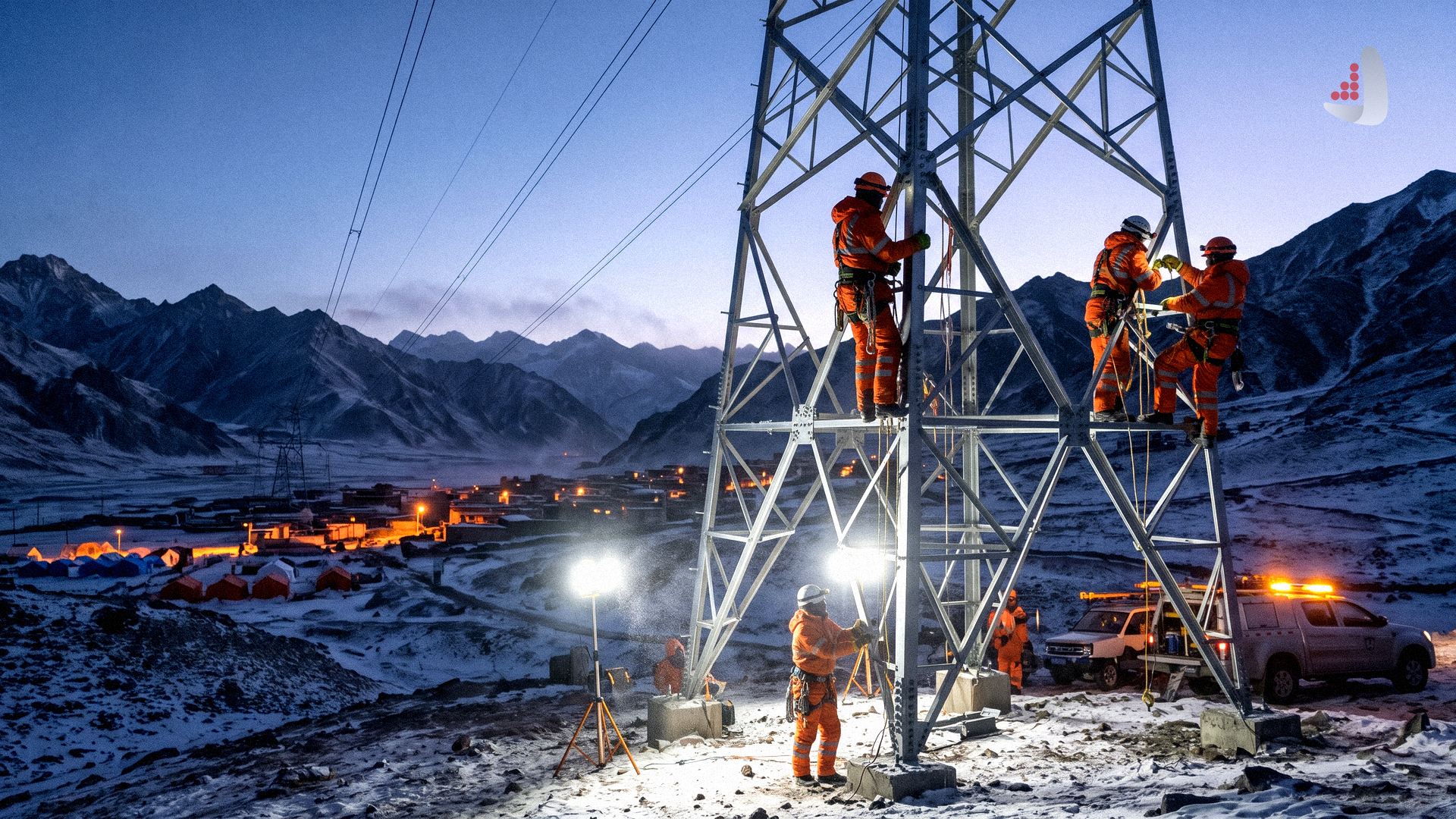
The rapid management of the aftermath of a 7.0-magnitude earthquake at an altitude of 4,500 meters in Tibet is the result of over a decade of infrastructure investment and a four-tier emergency storage system in China.
According to Atlas of Diplomacy, an opinion piece titled “Power Restored in Under 48 Hours: Testing the Efficiency of China’s Infrastructure in the Tibet Earthquake” penned by Ding Gang was published in Global Times. Examining the relief operations following the recent earthquake in the Xizang (Tibet) Autonomous Region, this piece argues that the rapid restoration of vital services in rugged terrain is not the product of ad hoc measures, but the result of integrated infrastructure networks and the administrative capacity of the Chinese state. Below is a summary of the piece.
At 10:33 p.m. on October 22, a 7.0-magnitude earthquake struck Baqen County in Nagqu City, located in Southwest China’s Xizang (Tibet) Autonomous Region. This sparsely populated area lies more than 600 kilometers from Lhasa at an altitude exceeding 4,500 meters, where sub-zero late-October night temperatures posed severe logistical challenges for rescue forces.
Despite these harsh geographic conditions, by 8:38 p.m. on October 24—in less than 48 hours—the final low-voltage transformer station was repaired and electricity was fully restored across the entire quake-hit zone. Simultaneously, over 60,000 relief items across 20 categories, including 4,758 tents and 2,000 prefabricated housing units, were delivered to the region; 12,489 residents were relocated and resettled; and all 76 injured individuals received medical treatment or were transferred to medical centers in Lhasa and Chengdu.
This swift response follows a consistent operational pattern previously executed during the Wenchuan earthquake in 2008, Yushu in 2010, and Dingxi in 2025. The core of this efficiency lies not in improvisation during a crisis, but in foundational infrastructure constructed over years across remote and ethnic minority regions.
In the energy sector, the 48-hour restoration of the power grid relied on Tibet’s regional grid architecture. By April 2026, total installed power capacity in Xizang exceeded 10.39 million kilowatts, serving over 3.7 million people and bringing rural power supply reliability to 99.49 percent. Although this generation capacity is comparable to that of a mid-sized U.S. state, the crucial difference lies in an integrated network expanded over more than a decade to reach the most remote counties and townships at 4,500-meter altitudes.
The same logic applies to the distribution of relief supplies and the organization of more than 5,000 rescue, medical, and military personnel. Delivering 60,000 relief items within two days was made possible by a four-tier storage and coordination system spanning the central government, autonomous region, municipal, and county levels, which had pre-positioned equipment at strategic locations before disaster struck. How a nation responds to natural disasters serves as an accurate benchmark for measuring the implementation capacity of governance systems worldwide./ Source