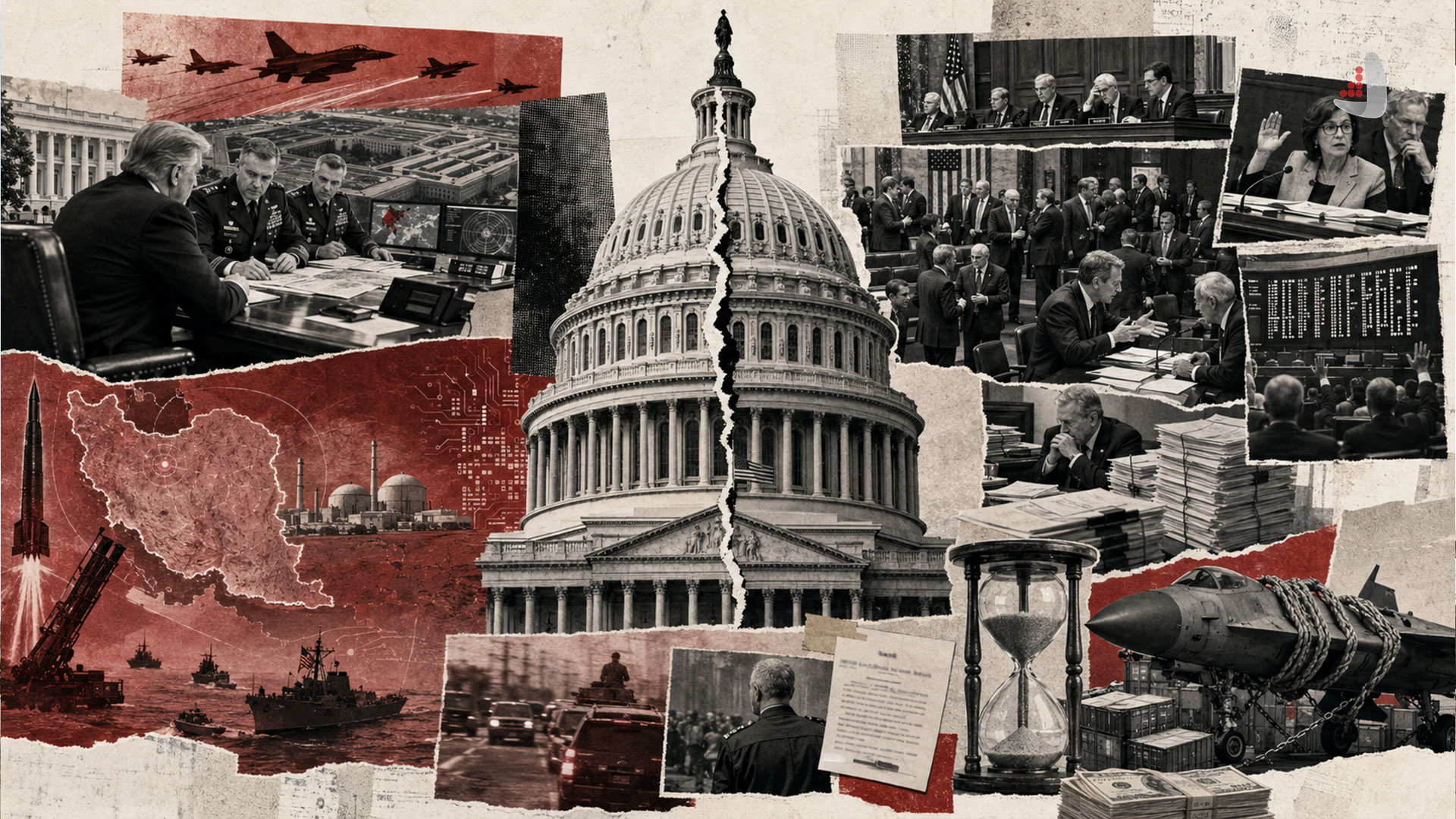
In discussions of a possible war between the United States and Iran, the U.S. Congress—an important institutional variable—is often treated as an afterthought. Attention usually centers on the White House, the Pentagon, Israel, Iran’s nuclear program, or the network of forces aligned with Tehran. Constitutionally, Congress holds the power to declare war, appropriate funds, and oversee the executive branch. Yet the strategic question is not whether Congress possesses power on paper, but at what stage of a crisis it can actually constrain presidential behavior. Congress will probably be unable to prevent an initial, limited strike against Iran or Iran-aligned forces, but it can still exert a decisive influence over the war’s scope, duration, and political legitimacy. That distinction matters because crises between the United States and Iran tend to unfold rapidly, across multiple theaters, and under conditions of profound ambiguity.
The central disruption in the institutional balance stems from the evolution of U.S. “war powers.” The Constitution gives Congress the authority to declare war, but the experience of recent decades has shown that presidents can act before a legislative consensus takes shape and then justify their actions as necessary to defend U.S. forces, protect national interests, or exercise the commander in chief’s inherent authority. Contrary to its original purpose, the 1973 War Powers Resolution has become less an effective barrier to unilateral action in advance than a mechanism for “notification after the fact,” because it allows the president to continue military operations for up to 60 days without new authorization. The legal legacy of the 2001 Authorization for Use of Military Force has also entrenched a broader logic of executive power in U.S. national security policy, even if a conflict involving Iran would not fall squarely within its scope.
The Iran file magnifies this executive advantage because crises between the two countries rarely begin as conventional wars. Military action by Iran’s allies, a maritime confrontation, cyber operations, an imminent threat to U.S. forces in the region, or a significant advance in Iran’s nuclear program could all be treated in Washington as circumstances demanding a rapid response. Under such conditions, the speed of the crisis works in the president’s favor and against Congress. Congress is a deliberative, legislative institution that needs time to build coalitions, convene hearings, draft language, and hold votes. By contrast, the logic of deterrence and crisis management allows the president to argue that delay carries security costs. In the most likely scenario, therefore, Congress enters the arena not over whether the crisis begins, but over how it continues.
The experience of 2020 made the importance of this timing gap unmistakable. After the assassination and martyrdom of Major General Qassem Soleimani, the Senate and then the House of Representatives sought, through a resolution, to limit U.S. participation in unauthorized hostilities against Iran. Yet the measure came only after facts had already been created on the ground and could not reverse the trajectory of the crisis. The analytical lesson is that Congress’s weakness is not absolute, but temporal. Had the same constraints been enacted before the crisis—as binding law, stringent reporting requirements, or a clear prohibition on using funds for an attack on Iranian territory—the president might still have been able to undertake limited action, but its legal, political, and coalition costs would have been higher. Congress is therefore less a tool for stopping the “first strike” than a mechanism for reshaping the architecture of decision-making before a crisis begins.
From this point, Congress’s real role becomes clear at three levels. First, in a prolonged or expanding war, Congress becomes indispensable because sustained operations require supplemental funding, munitions stockpiles, support for regional deployments, and domestic political tolerance for the costs. Second, Congress sends a political signal to foreign actors. Iran, Israel, and America’s Arab partners along the Persian Gulf do not look only to the president’s position; they also assess whether a durable bipartisan consensus stands behind the White House. Fragile congressional support may encourage Tehran to test Washington’s limits, just as strong backing may embolden some U.S. regional partners to take greater risks. Third, Congress can raise the cost of escalation through sanctions, oversight conditions, sunset clauses for existing authorities, and requirements that the administration publicly disclose its legal rationale.
Common interpretations of Congress usually contain two errors. The first holds that Congress has become effectively irrelevant and that the president can start a war whenever he chooses. The strength of this view is that it reflects operational reality, but its weakness lies in ignoring the problem of sustaining a war. Even a president who launches a conflict without authorization needs political support and funding for a war of attrition. The second view holds that Congress can end a war whenever it chooses simply by cutting off funding. Legally, that argument is attractive, but politically, it is far more difficult. Once U.S. forces are engaged, a vote to terminate funding can be portrayed as weakening the troops. The more persuasive conclusion is that Congress is weak at the threshold of crisis, hesitant in the middle of it, and potentially decisive in a prolonged war.
The consequences of this condition operate at several levels. Domestically, congressional passivity lowers the threshold for the use of force and erodes democratic oversight of war. Regionally, actors in West Asia may conclude that Washington faces few political constraints as it moves up the “conflict escalation ladder.” The result may be increasingly dangerous calculations by Iran or by its regional rivals. Internationally, the absence of clear congressional backing can weaken the legitimacy and durability of any coalition. America’s European and Asian allies are generally more flexible when it comes to limited defensive operations than to an open-ended war. A second-order consequence is equally important. If Congress fails to draw clear boundaries, both sides will rely more heavily on subthreshold tools—including limited strikes, cyber operations, and ambiguous deterrence—making the cycle of crisis more enduring.
Three scenarios appear more plausible than the rest. Under the first, “limited conflict with tacit approval,” an attack by Iran-aligned forces or a significant nuclear advance prompts the president to take limited action, and Congress later accepts it in practice through hearings. Warning signs would include an increase in security hearings without a binding restrictive measure, accompanied by bipartisan emphasis on “protecting U.S. forces.” Under the optimistic scenario of “pre-crisis restraint,” a bipartisan coalition conditions any attack on Iranian territory on explicit authorization before the crisis begins. This is less likely, but serious movement toward war powers reform, sunset clauses for open-ended authorities, and public legal reporting would signal its emergence. Under the pessimistic scenario of a “triggering shock and broad authorization,” an attack causing heavy U.S. casualties, or a high-confidence judgment that Iran’s nuclear program is accelerating, pushes Congress toward a sweeping authorization for the use of force. Confidence in these projections is moderate because the partisan composition of Congress, the electoral calendar, the scale of U.S. casualties, and intelligence assessments of Iran’s nuclear program could all alter the outcome.
Congress’s role in any future war with Iran should not be understood through the simple binary of being either able or unable to prevent war. The real question is at what stage of a crisis Congress can exert influence. Institutional and empirical evidence suggests that Congress is unlikely to stop an initial, limited action, but it can shape the war’s scope, duration, legitimacy, and political cost. That distinction is vital because many wars do not begin with a formal declaration. They begin with limited actions that later open the way to much larger trajectories. The uncertainty lies in whether Congress will establish stronger restraining rules before the crisis or once again respond only after facts have been created on the ground. The central question is whether Washington intends to manage the decision over another war with Iran through ambiguous executive authorities, or whether it is prepared to bear the political cost of returning the decision for war to the legislative process.