Despite their differences over Iran, Trump and Carlson are aligned on immigration and Ukraine.
According to Atlas Diplomacy, an article titled “The Hidden Common Ground Between Trump and Tucker Carlson,” written by Sasha Abramsky, has been published in The Nation. Examining Donald Trump and Tucker Carlson’s shared positions on immigration, the war in Ukraine, and authoritarian models of governance, the article shows that their disagreement over the war with Iran has not erased the overlap in their views on key domestic and foreign policy issues. The following is a summary of the article.
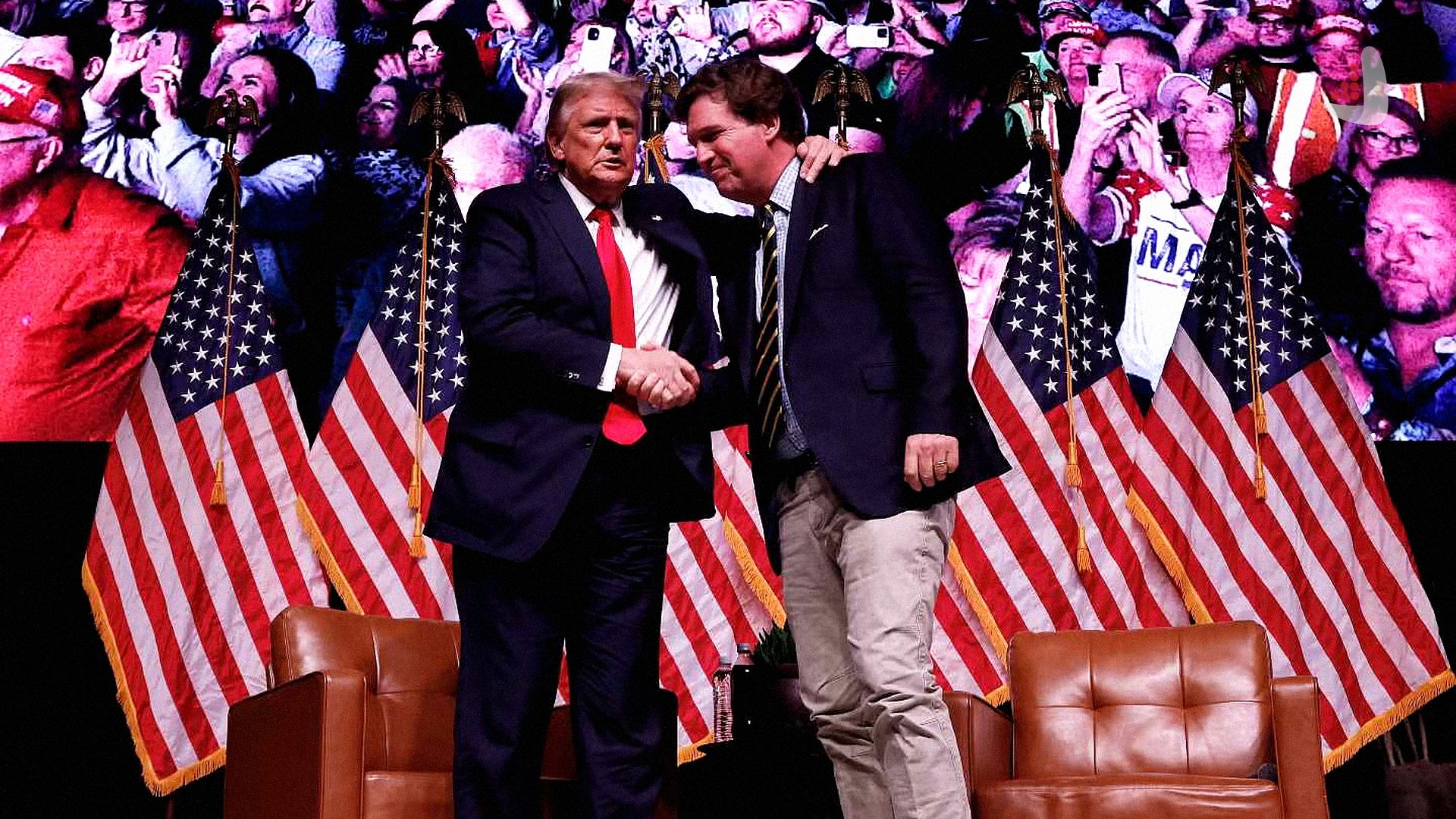
The disagreement between Donald Trump and Tucker Carlson over the war with Iran does not mean that they have moved away from their shared ideological frameworks on immigration, the war in Ukraine, and authoritarian governance. Despite differences in their positions on specific issues at particular moments, both figures promote approaches that portray immigrants as threats to national identity and security, while presenting Western support for Ukraine as a costly and unnecessary measure against Russia. This alignment demonstrates that disagreement over a regional conflict does not necessarily lead to a rupture in underlying political and ideological foundations.
In an interview with Jacob Rees-Mogg, a British politician and supporter of Brexit, Carlson defended Russia’s arguments regarding the war in Ukraine and criticized Western governments for supporting Kyiv. He also provoked a critical response from his interlocutor by expressing views on World War II, including downplaying the consequences of Nazi Germany’s victory. On immigration, Carlson described migrants entering through the English Channel as an invasion and characterized it as a greater threat to Britain than the historical threat posed by Nazism. These positions transform immigration from a social and administrative issue into an existential threat, paving the way for the justification of military and coercive approaches.
In the United States, the Trump administration’s policies toward immigrants have also been accompanied by increased reliance on security measures and violent enforcement practices. Reports have emerged of vehicles operated by U.S. Immigration and Customs Enforcement agents colliding with migrants and protesters. Meanwhile, the Department of Homeland Security’s request to the Pentagon for non-lethal thermal energy weapons has raised concerns about the expansion of punitive tools. When such approaches are combined with portrayals of immigrants as internal enemies, they can weaken the distinction between law enforcement and the use of violence against vulnerable groups. Trump has also attributed protests in France to immigrants, Islamists, and communists, remarks that drew criticism from Emmanuel Macron.
At the same time, Trump and Carlson’s positions on Ukraine overlap with narratives promoted by the Kremlin. In recent years, Carlson has praised Vladimir Putin and defended Russia’s arguments for justifying its invasion of Ukraine. Trump, too, has weakened Ukraine’s position in practice by calling for Volodymyr Zelenskyy to step down, proposing the replacement of Ukrainian negotiators, restricting intelligence cooperation and military aid, and easing sanctions pressure on Moscow. A reduction in Western support could constrain Kyiv’s defensive capabilities and increase the human cost of the war for civilians. Within this framework, Russia is presented not merely as an aggressor, but also as a model of centralized governance, Christian nationalism, and leadership based on personal authority.
The prospect of a meeting between Trump, Putin, and Xi Jinping in China has also raised questions about the future of the international order. Although nuclear disarmament could be a positive objective, the absence of clear evidence of verifiable mechanisms and enforceable commitments increases the possibility that such a summit could become a political spectacle. Rather than strengthening international agreements, such a meeting could pave the way for the division of spheres of influence among major powers. At the same time, the Trump administration’s emphasis on a substantial increase in military spending, the militarization of space, and a renewed positive view of the colonial legacy has intensified concerns about the return of power-based politics. Overall, the combination of nationalism, weakened support for Ukraine, and a willingness to pursue agreements among powerful leaders could shift the rules-based international order toward competition over spheres of influence and the erosion of democratic constraints./ Source